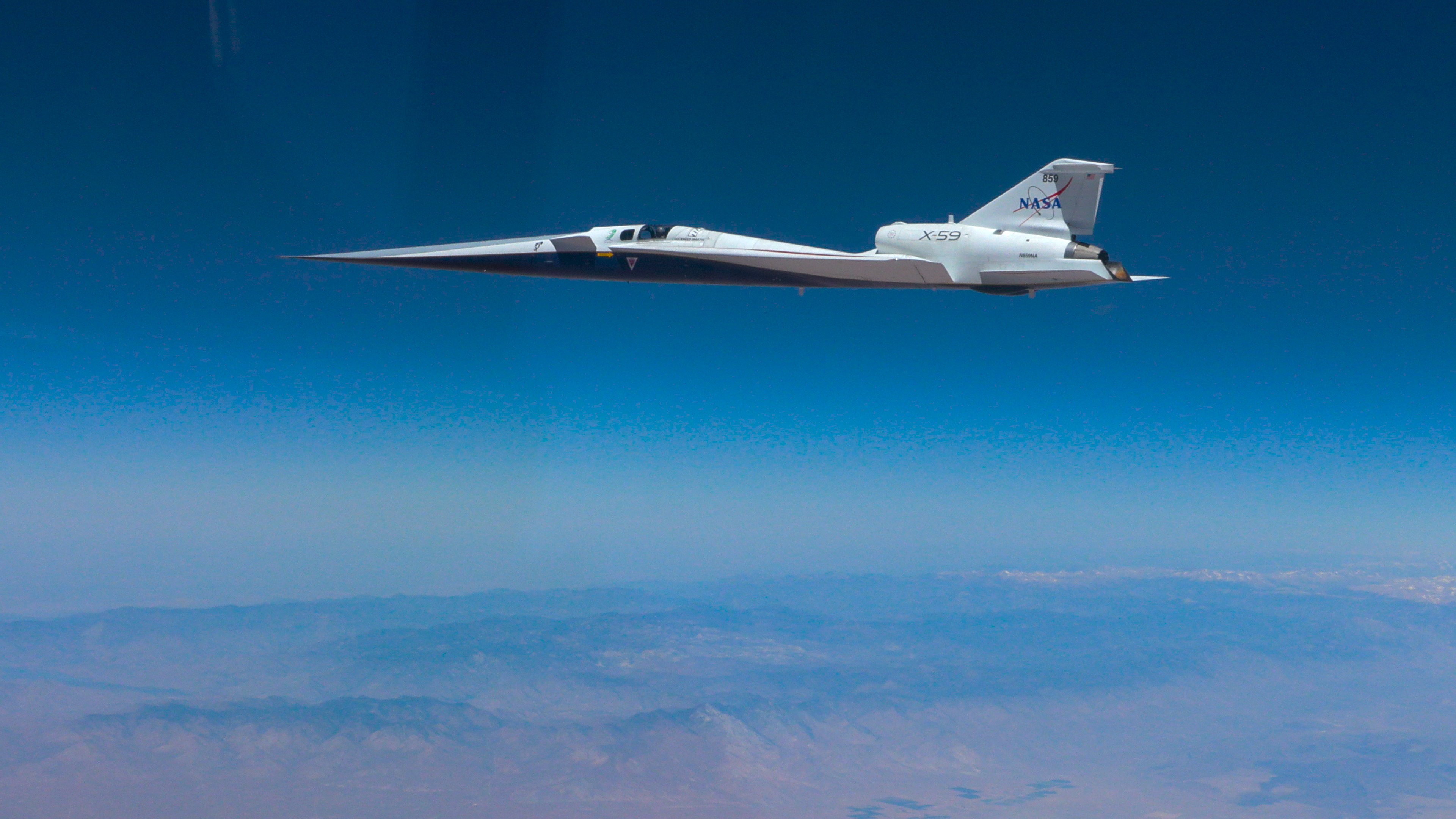


NASA's experimental X-59 aircraft flew faster than the speed of sound for the first time, a moment that brings the long-stalled idea of supersonic passenger travel back into serious view. The flight took place above Edwards Air Force Base in California on 5 June 2026, lasted81 minutes, and reached a top speed of around Mach 1.1, roughly 713 miles per hour, at an altitude of about 43,400 feet. For a project years in the making, it marked the moment the aircraft finally does the one thing it is built to do.
Why this flight matters
The significance lies not in the speed itself but in the noise. When most aircraft pass the sound barrier, they create a sharp, startling sonic boom. That single problem is the reason commercial supersonic flight over land remains banned in the United States since 1973. The X-59 is designed to replace the boom with a much softer sound that engineers describe as a gentle thump. If the design works as intended, it removes the main obstacle that keeps fast travel grounded for half a century.
This first supersonic flight does not yet test the quiet thump in front of the public. Instead, it confirms that the aircraft handles well as it crosses from normal speeds into supersonic ones. That stability is an essential building block. Engineers need to know the aircraft is safe and predictable before they can study the sound it makes.
What comes next
The X-59 team now plans a series of more demanding flights. In the coming weeks the aircraft aims to reach Mach 1.4 at an altitude of about 55,000 feet, the conditions under which its noise will be properly measured. Later tests will see the jet fly over selected communities in the United States so that researchers can gather data on how people on the ground perceive the sound. That human response is the real prize, because regulators will want hard evidence before they consider changing the rules.
From experiment to passenger flight
For now the X-59 remains strictly experimental. It is a single research aircraft, not a prototype for an airliner, and it carries no passengers. Its purpose is to produce the data that future regulation can rest on. Whether that data leads to commercial aircraft depends on manufacturers, airlines and lawmakers, and any such jet remains years away.
Even so, the importance of the work is clear. The X-59 is designed to prove a principle, that an aircraft can travel faster than sound without disturbing the people below. If the quiet thump holds up under scrutiny, it could give the aviation industry the evidence it needs to revisit a ban that has shaped air travel for two generations. The next flights will show whether the promise survives contact with the real world.