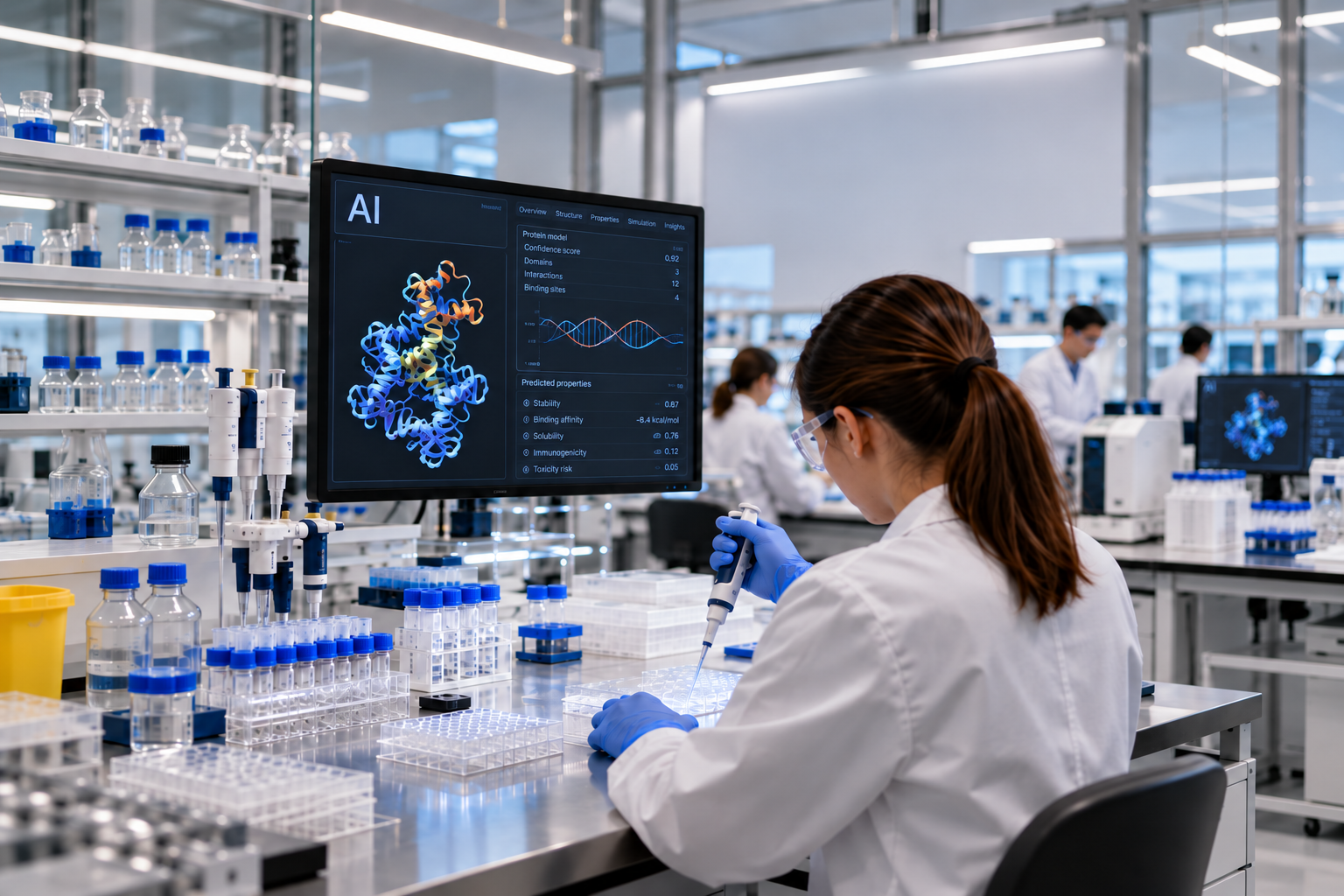


Artificial intelligence company Anthropic is expanding further into life sciences, combining its Claude AI models with physical laboratory research as it explores how artificial intelligence could support biological discovery.
The company has established a wet laboratory in the San Francisco Bay Area, allowing its researchers to move beyond computer-based biological modelling and test ideas through physical experiments.¹
Anthropic's expansion into laboratory research is part of a wider effort to explore how AI could accelerate scientific work in areas including biology, medicine and early-stage drug research.
That effort has already produced an early research result. On September 23, Anthropic said Claude had contributed to the discovery of a previously unknown enzyme system with characteristics similar to mechanisms found in CRISPR gene-editing technology.²
Moving AI From Software Into the Laboratory
Generative AI has already demonstrated an ability to analyse scientific literature, work with large datasets and assist researchers with computational tasks.
Anthropic is now exploring what happens when those capabilities are connected more directly with physical experiments.
The company's wet lab allows biological research to be tested in real-world laboratory conditions rather than relying entirely on computer simulations.
Eric Kauderer-Abrams, Anthropic's head of life sciences, told Reuters that physical laboratory testing remains essential for biological research, even as increasingly capable AI systems become involved in the process.¹
The company is also examining how Claude could interact with laboratory automation, including robotic equipment capable of carrying out experiments.
Anthropic has emphasised that human oversight remains important as these technologies develop.¹
An Early Scientific Result
Anthropic's biology programme gained further attention in September when the company announced that Claude had helped researchers identify a novel enzyme system.
The system showed properties reminiscent of mechanisms used in CRISPR, the technology that allows scientists to make targeted changes to genetic material.²
The finding represents an early example of Anthropic's AI being used as part of an active biological research process rather than simply analysing existing scientific information.
However, it remains early-stage research.
Discovering a biological mechanism does not automatically translate into a new medicine or commercially usable technology, and scientific findings require further testing and validation.
The significance at this stage is therefore less about an immediate medical product and more about demonstrating another way AI can participate in the research process.
Exploring Difficult Areas of Drug Research
Anthropic has said it is particularly interested in areas of biology that may historically have been difficult or commercially unattractive to pursue.
One potential application is research into conditions considered difficult to treat or previously described as "undruggable."
AI could potentially help researchers investigate larger numbers of biological targets, analyse complex molecular relationships and identify possible approaches more quickly than through traditional methods alone.
Anthropic has discussed using its technology to support work on complex biological molecules, including bispecific and trispecific antibodies that can interact with multiple biological targets.¹
The company has not disclosed specific diseases being targeted through its internal research programme.
It has also said it does not currently intend to run clinical trials, maintaining a distinction between its research activities and pharmaceutical companies responsible for taking medicines through human testing and regulatory approval.¹
Building an AI Toolkit for Scientists
The physical laboratory forms part of a broader expansion of Anthropic's life-sciences activities.
In June, the company launched Claude Science, an AI workbench designed to help researchers work across scientific databases, analysis tools, programming environments and computing resources.³
Anthropic has also developed tools intended to allow AI systems to interact with laboratory equipment and has expanded its scientific workforce.
Life sciences has become one of the company's larger investment areas in terms of people and resources, according to its head of life sciences.¹
The company already works with pharmaceutical and biotechnology businesses, including organisations associated with Roche, Bristol Myers Squibb and Novo Nordisk.¹
AI's Growing Role in Scientific Discovery
Anthropic's expansion reflects a much wider trend across the technology and pharmaceutical industries.
AI systems are increasingly being explored for tasks ranging from predicting protein structures and analysing genetic information to identifying potential molecules and designing experiments.
The attraction is partly speed.
Scientific discovery often involves testing enormous numbers of possible biological interactions, reviewing large bodies of research and repeating experiments over long periods.
AI may help researchers narrow those possibilities more efficiently, although laboratory validation and human expertise remain essential.
Anthropic's decision to establish its own physical biology facilities takes that idea a step further by bringing AI-assisted reasoning, laboratory automation and real-world experimentation into the same research process.
From AI Assistant to Research Tool
It remains too early to determine how significantly AI will shorten the development of new medicines or biological technologies.
Drug development remains a lengthy process, and the majority of experimental medicines never successfully reach patients.
Anthropic's laboratory work therefore should not be viewed as evidence that AI can independently discover successful new treatments.
Instead, it demonstrates how frontier AI developers are beginning to move beyond purely digital applications and investigate how their models can contribute to physical scientific research.
The discovery of the novel enzyme system provides an early example of what that collaboration between scientists and AI can look like.
As those tools develop, biology could become one of the clearest testing grounds for whether increasingly capable AI systems can help accelerate meaningful scientific discovery.
Sources
- Reuters, Anthropic quietly sets up biology lab as it ramps AI drug program, September 18, 2026.
https://www.reuters.com/world/anthropic-quietly-sets-up-biology-lab-it-ramps-ai-drug-program-2026-09-18/ - Reuters, Anthropic says Claude AI helped discover novel enzyme system, September 23, 2026.
https://www.reuters.com/business/healthcare-pharmaceuticals/anthropic-says-claude-ai-helped-discover-novel-enzyme-system-2026-09-23/ - Anthropic, Claude Science, an AI workbench for scientists, is now available, June 30, 2026.
https://www.anthropic.com/news/claude-science-ai-workbench
Disclaimer
This article is for informational purposes only and is based on publicly available information at the time of publication. It does not constitute medical, scientific, financial or investment advice. Anthropic's biological research remains at an early stage, and early scientific findings do not guarantee the development of successful medicines or other commercial applications.