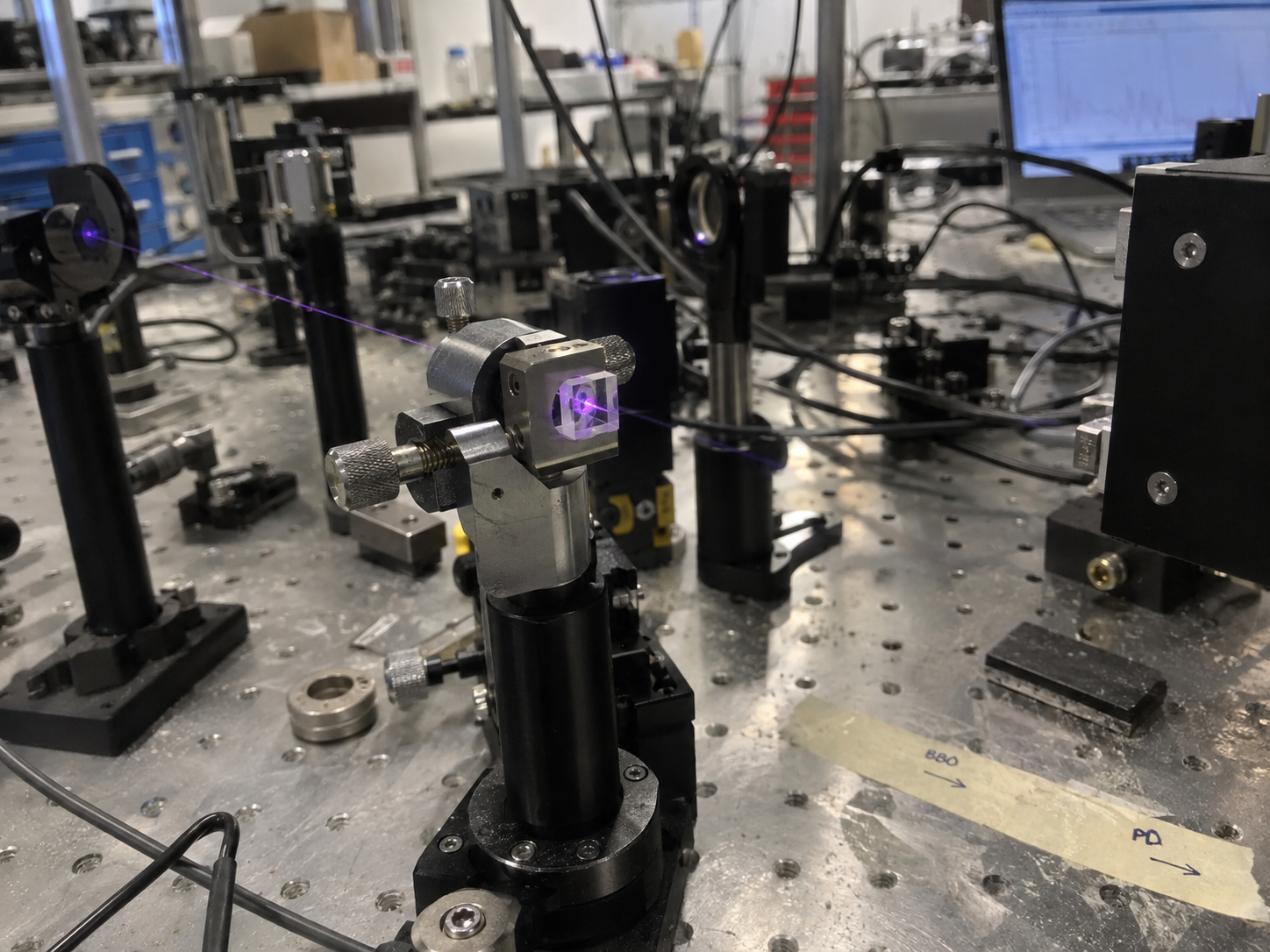


Two research teams, one in Europe and one in China, report that they have built the first nuclear clocks that can run on their own. Both studies appear in the journal Nature on 7 October 2026. The clocks use the nucleus at the centre of an atom, rather than the electrons around it, to measure time. Scientists have worked towards this goal for decades. A working nuclear clock could one day improve satellite navigation, help explore deep space and test some of the most basic ideas in physics.
The European team comes from TU Wien in Austria and PTB, Germany's national metrology institute. It is led by Professor Thorsten Schumm and Professor Ekkehard Peik. The Chinese team is based at Tsinghua University in Beijing and is led by Ding Shiqian, working with researchers from 13 other Chinese institutions. The two groups work independently but reach the same point at the same time.
How a Nuclear Clock Works
Every clock needs something that repeats at a steady rate. Modern atomic clocks use electrons, which jump between energy levels when light of an exact frequency hits them.
A nuclear clock uses the same idea, but inside the nucleus. Both teams use thorium-229, a rare form of the element thorium. Its nucleus has two energy states that are very close together. This small gap means an ultraviolet laser, at a wavelength of 148 nanometres, can move the nucleus from one state to the other. The thorium atoms sit inside a small crystal of calcium fluoride.
The key step in both studies is a feedback loop. The thorium nuclei only absorb the laser light when its frequency is exactly right. If the laser starts to drift, the nuclei absorb less light. The system measures this and corrects the laser automatically. Professor Schumm describes it plainly: "The basic idea is simple: you have a laser and you have thorium."
Until now, thorium experiments needed a separate atomic clock to keep the laser on target. The new clocks no longer need that support.
Two Different Results
The Vienna clock runs steadily for more than 24 hours without help. Over one day, it reaches a precision of about one part in a million billion. The team says this is roughly equal to losing one second every 30 million years.
The Beijing team takes a different technical route. It uses a new continuous ultraviolet laser and a crystal made with only 1.4 micrograms of thorium-229. That is about 200 times less thorium than the European team uses, which matters because thorium-229 is extremely rare. Chinese state media reports that the Beijing clock is almost ten times more stable over short periods than the Vienna clock. This comparison comes from media reports rather than an independent review.
The two results build on fast progress. In April 2024, the Vienna and PTB teams first show that a laser can change the state of a thorium nucleus. Later that year, they build a clock that uses thorium alongside a conventional atomic clock. Just two years later, nuclear clocks are working on their own.
Why It Matters
The main advantage of a nucleus is its size. A nucleus is more than 10,000 times smaller than a whole atom. This makes it much less sensitive to outside disturbances such as electric and magnetic fields. In theory, a nuclear clock can therefore stay accurate in places where today's clocks struggle.
Researchers point to several possible uses. Precise clocks are at the heart of satellite navigation, including GPS. More stable clocks could support better navigation for spacecraft travelling far from Earth. Small, portable nuclear clocks could also measure tiny changes in gravity underground, which could help geologists study the Earth.
There is a scientific use too. Physicists hope to use these clocks to test whether the basic constants of nature stay fixed over time. One expert outside the projects, Adam Dunford of New Zealand's Measurement Standards Laboratory, notes that nuclear clocks could one day help redefine the second.
What Comes Next
Both teams are clear that their clocks are early prototypes. Neither clock yet matches the accuracy of the world's best optical atomic clocks, which use electrons and remain the most precise timekeepers available. The Vienna results also cover only a single day of operation.
The next steps are practical. The Vienna team plans to use stronger lasers and better thorium crystals to improve precision. The Beijing team's success with a very small amount of thorium may help make future clocks cheaper and easier to build.
For now, nuclear clocks move from a laboratory idea to a working device that keeps its own time. Turning that device into a tool for navigation or space travel will take several more years of careful work.