

In mid-December 2025, two separate strands of scientific research captured attention for very different reasons. Engineers in the United States unveiled some of the smallest autonomous robots yet created, while climate researchers published updated projections on the long-term disappearance of glaciers. One story concerns machines measured in millimetres. The other concerns ice masses measured in kilometres. Together, they reflect the breadth of modern scientific ambition.
Miniaturising autonomy
Teams at the University of Pennsylvania and the University of Michigan reported progress in building autonomous micro-robots capable of basic movement and environmental interaction. Unlike earlier prototypes that required tethers or external magnetic fields, these devices integrate onboard power and control systems within extremely small frames.
The challenge in micro-robotics is not simply scale. Shrinking a machine requires rethinking materials, power delivery and control logic. Conventional batteries and motors do not scale down easily. Researchers have had to experiment with new fabrication techniques, lightweight materials and simplified mechanical systems.
Potential applications range from targeted drug delivery inside the human body to environmental sensing in hazardous locations. In medicine, micro-robots could one day navigate blood vessels to deliver therapies directly to affected tissues. In industrial settings, they might inspect infrastructure in confined spaces.
For now, most systems remain experimental. Their reliability, durability and cost remain open questions. But the direction of travel is clear. As components become smaller and more efficient, autonomy is moving into domains once considered inaccessible.
Tracking irreversible change
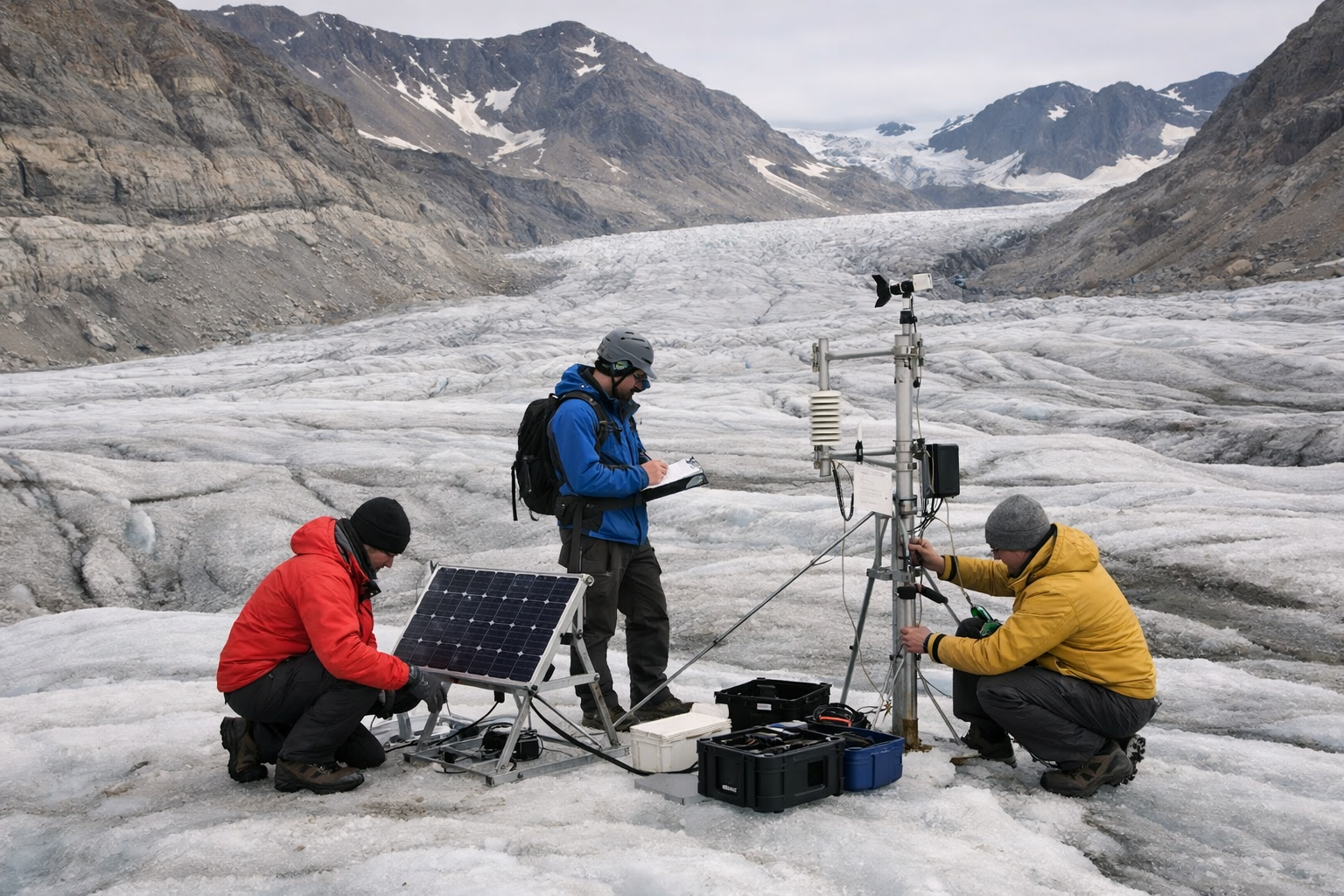
At the same time, climate scientists released updated modelling on glacier retreat, including projections identifying points at which ice loss becomes effectively irreversible. These studies draw on satellite data, temperature records and long-term simulations to estimate when certain glacier systems may pass critical thresholds.
Glaciers serve as freshwater reservoirs for hundreds of millions of people. Their gradual decline alters river flows, agricultural cycles and regional water security. Unlike seasonal weather events, glacier retreat unfolds over decades. The pace can appear slow, yet the cumulative impact is significant.
Improved modelling does not change the underlying physics of warming, but it refines understanding of timing and scale. Policymakers rely on such projections to assess infrastructure planning, flood risk and long-term adaptation strategies.
A shared theme of scale
The juxtaposition of these developments is striking. One field compresses engineering into ever smaller physical dimensions. The other confronts environmental change unfolding across vast landscapes.
Both, however, depend on advances in modelling, materials science and data analysis. Micro-robots rely on precision manufacturing and embedded control systems. Climate projections rely on high-resolution data and increasingly sophisticated simulations.
Scientific progress often occurs simultaneously at opposite ends of the scale spectrum. In December 2025, the smallest machines and the slowest-moving ice offered a reminder that innovation and environmental change are advancing in parallel. Understanding both requires patience, measurement and a willingness to think across dimensions.