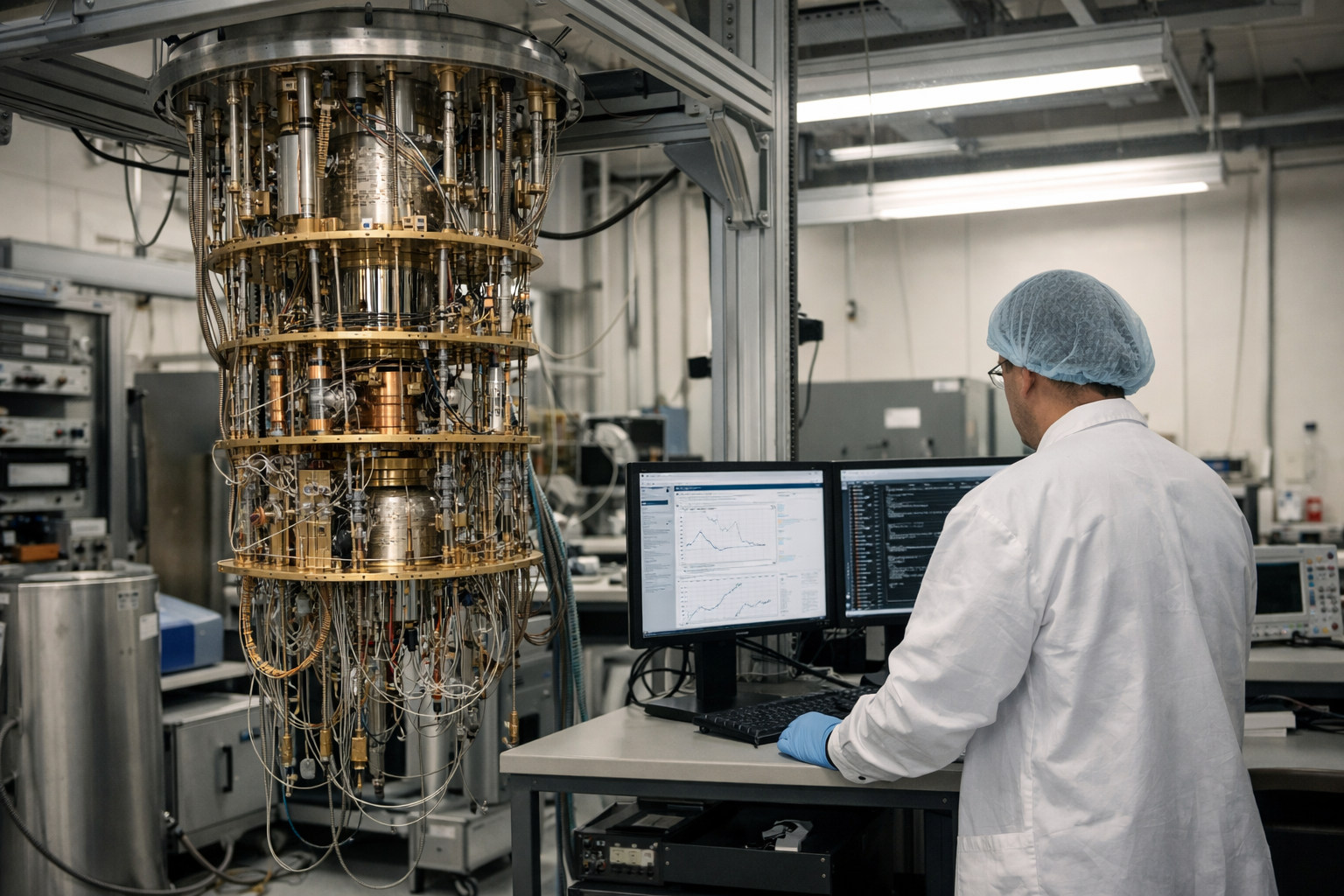


Researchers report measurable progress in reducing error rates in quantum computing systems. While the field remains experimental, incremental improvements in stability and control narrow the gap between laboratory prototypes and usable machines.
Quantum computers differ from conventional systems by using quantum bits, or qubits, which can represent multiple states simultaneously. In theory, this allows certain calculations to be performed far more efficiently than on classical computers. In practice, qubits are highly sensitive to interference from their environment. Even minor fluctuations in temperature or electromagnetic noise introduce errors.
The challenge of error correction
Error correction remains one of the central obstacles in quantum computing. Unlike classical bits, which are either 0 or 1, qubits exist in fragile quantum states. Maintaining coherence long enough to complete meaningful calculations requires sophisticated control systems.
Recent research demonstrates lower physical error rates in qubit operations, alongside improvements in stabilising multi-qubit systems. Some experimental platforms show error probabilities reduced to fractions of a per cent per gate operation. While that remains high compared with classical computing standards, it represents steady progress in a field where reliability limits scalability.
The significance lies not in a single breakthrough, but in cumulative refinement. As error rates fall, the number of qubits required for reliable, fault-tolerant computation decreases. That reduces the physical and financial scale of machines needed to perform advanced tasks.
From theory to application
Quantum computing is often associated with theoretical promise, yet researchers and technology firms increasingly target specific applications such as materials modelling, optimisation problems and aspects of cryptography.
Simulating molecular interactions for drug discovery or advanced battery materials involves complex probability calculations that strain classical systems. Quantum approaches may offer advantages in these specialised areas.
Governments and private firms continue to invest heavily in quantum research. Industry estimates place global public and private funding in quantum technologies at tens of billions of pounds over the past decade. The objective extends beyond scientific leadership to long-term economic competitiveness.
A measured outlook
Large-scale, fault-tolerant quantum computers remain some distance away. Most current systems operate with limited qubit counts and require tightly controlled laboratory environments, often at temperatures close to absolute zero.
Progress remains incremental rather than dramatic. Each reduction in error rates and each increase in qubit coherence time moves practical deployment closer, but no single threshold marks immediate transformation.
For policymakers and industry leaders, the key question is timing. Investment decisions depend on expectations about when quantum systems outperform classical alternatives for defined tasks.
The current trajectory suggests that technical barriers are being addressed methodically. Quantum computing does not yet reshape everyday technology, but it advances steadily from theoretical promise toward practical capability.