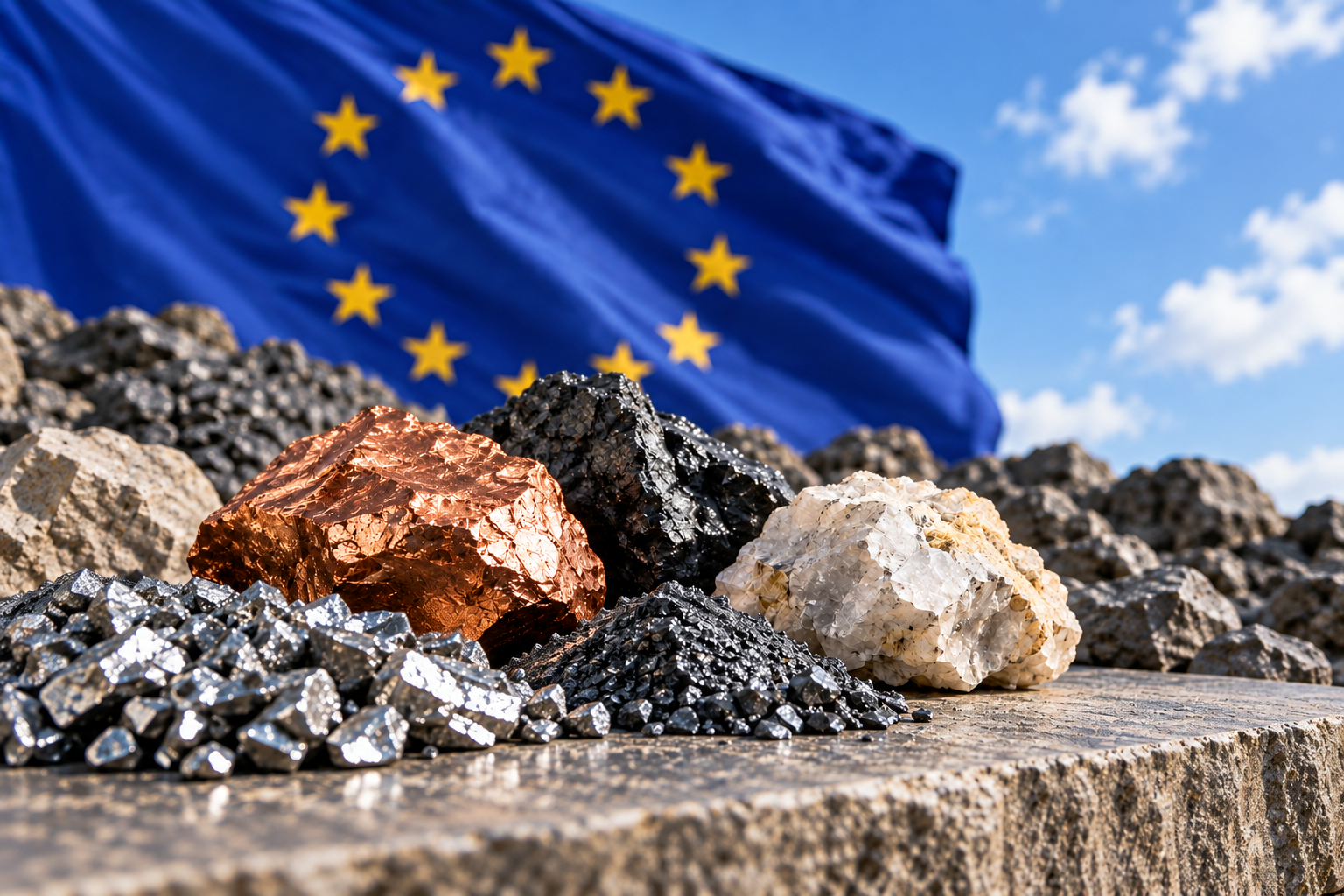


The European Commission has selected 46 new Strategic Projects across 16 EU countries as part of its effort to strengthen access to the critical raw materials needed for sectors including defence, aerospace, clean energy, automotive manufacturing and digital technologies.
Announced on October 9, the latest projects form the second group approved under the European Union's Critical Raw Materials Act and are expected to require approximately €21.1 billion in investment.
The projects cover materials including lithium, copper, nickel, cobalt, graphite and rare earth elements, expanding Europe's efforts to develop more extraction, processing and recycling capacity within the region.¹
Building More Diverse Supply Chains
Critical minerals are used across a growing range of modern technologies.
Lithium and graphite are important for batteries, copper is extensively used in electricity infrastructure and electronics, while rare earth elements are required for products ranging from wind turbines to advanced defence and aerospace systems.
However, the production and processing of many of these materials is currently concentrated in a relatively small number of countries.
The European Commission says its Critical Raw Materials Act is intended to increase domestic capacity while reducing reliance on any single external supplier.²
By 2030, the EU is targeting domestic capacity equivalent to at least 10% of annual consumption from extraction, 40% from processing and 25% from recycling for strategic raw materials.²
46 Projects Across 16 Countries
The newly selected projects are located across Belgium, Bulgaria, Estonia, Finland, France, Germany, Greece, Italy, Lithuania, the Netherlands, Poland, Portugal, Romania, Slovakia, Spain and Sweden.²
They were selected from 102 applications submitted during the latest application process.
Among the projects are developments covering mining, processing and recycling, meaning the programme is not focused solely on extracting additional resources from the ground.
Projects include the Zinnwald lithium development in Germany and the Skouries project in Greece, alongside initiatives involving companies active in metals processing and recycling.¹
Together, the latest projects cover 15 of the 17 strategic raw materials identified by the EU.
Faster Development for Strategic Projects
Receiving Strategic Project status does not automatically guarantee EU funding.
However, selected projects can benefit from greater support in accessing financing and from streamlined permitting procedures intended to reduce development timelines.¹
The Commission considers the projects important to the security of Europe's supply of strategic raw materials and to the functioning of the EU internal market.²
More than €2 billion in public funding has already been mobilised for strategic raw-material projects, according to Reuters, although financing remains one of the challenges facing some developments.¹
The €21.1 billion estimated investment requirement for the latest projects therefore highlights both the scale of Europe's ambitions and the amount of capital required to develop new mineral supply chains.
Critical Minerals Become Increasingly Strategic
The announcement comes as critical raw materials receive growing attention from governments around the world.
The expansion of renewable-energy infrastructure, electric transport, semiconductor production, artificial intelligence infrastructure and advanced defence systems is increasing the strategic importance of reliable mineral supplies.
At the same time, geopolitical and trade tensions have highlighted the risks associated with concentrated supply chains.
The EU has responded through a combination of domestic projects, recycling initiatives and partnerships with mineral-producing countries outside the bloc.
The latest 46 projects add to those already approved under the Critical Raw Materials Act, bringing the total number of designated Strategic Projects to 106.²
Strengthening European Capacity
Developing mines, processing facilities and recycling operations can take years, meaning the projects announced today are unlikely to change Europe's mineral supply immediately.
Each project will also need to progress through financing, development and regulatory stages before reaching full production.
However, the latest selections provide a clearer picture of where Europe intends to expand its domestic raw-material capabilities.
With critical minerals becoming increasingly important to advanced manufacturing, energy infrastructure and defence, the programme represents another step in the EU's longer-term effort to establish more diverse and resilient supply chains.
Sources
- Reuters, European Commission picks 46 new strategic critical mineral projects, October 9, 2026.
https://www.reuters.com/business/aerospace-defense/european-commission-picks-46-new-strategic-critical-mineral-projects-2026-10-09/ - European Commission, Commission selects 46 new Strategic Projects to bolster the EU's supply of critical raw materials, October 9, 2026.
https://luxembourg.representation.ec.europa.eu/actualites-et-evenements/actualites/commission-selects-46-new-strategic-projects-bolster-eus-supply-critical-raw-materials-2026-10-09_en
Disclaimer
This article is for informational purposes only and is based on publicly available information at the time of publication. It does not constitute financial, investment or legal advice. Development timelines, financing requirements and production expectations for individual projects may change.