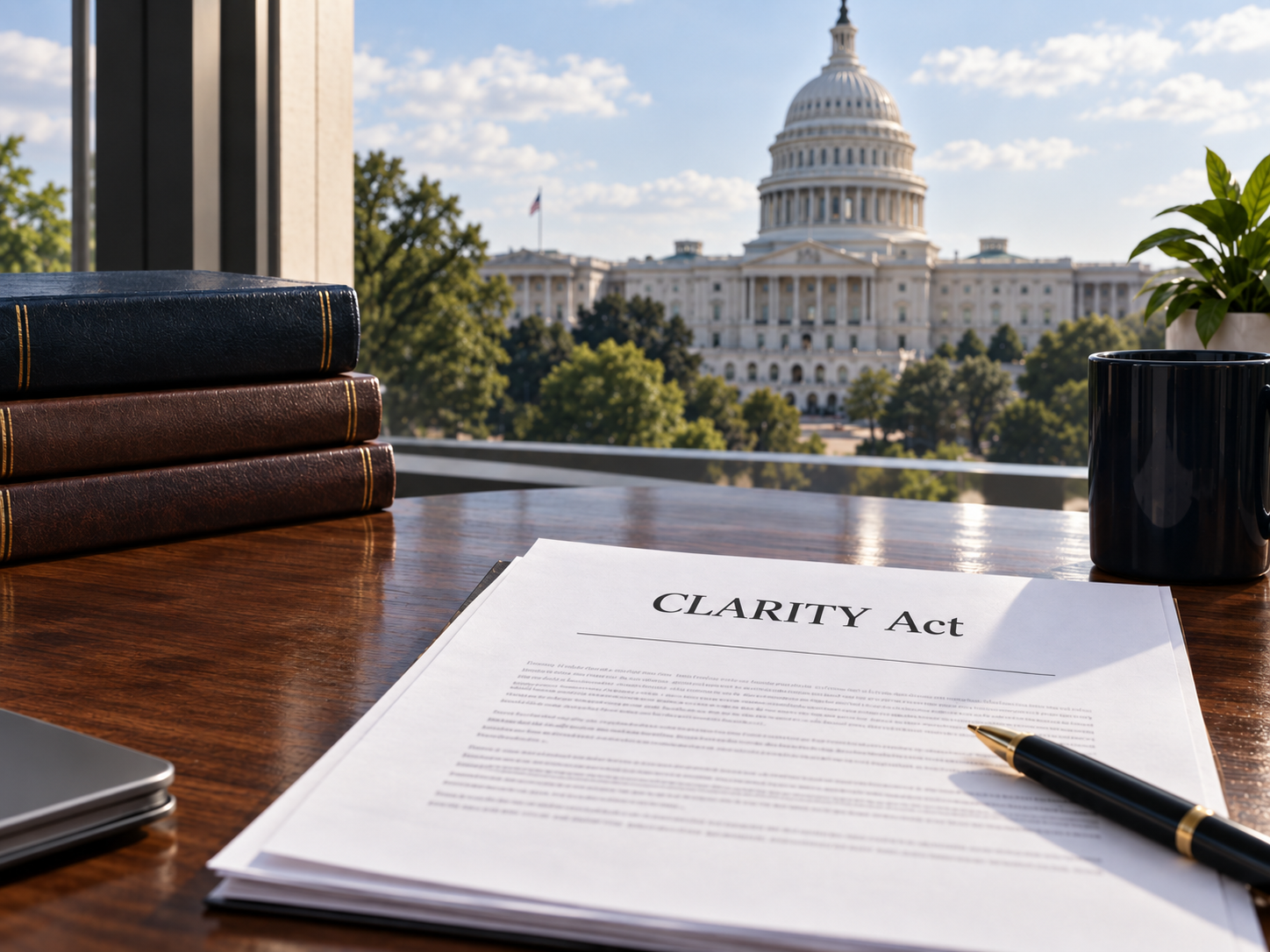


The United States' push to establish a clearer regulatory framework for digital assets remains firmly in focus following a closely watched Senate vote on the CLARITY Act.
On September 15, the Senate voted 50-49 on a procedural motion to advance the legislation, falling short of the 60 votes required. The result means the bill will not move forward in its current form for now, although the way the vote concluded leaves open the possibility that it could be reconsidered.
Rather than bringing the wider debate over US cryptocurrency regulation to an end, the vote highlights how far digital-asset policy has moved into the mainstream legislative agenda.
What Is the CLARITY Act?
The Digital Asset Market CLARITY Act is designed to establish a more defined federal framework for the regulation of digital assets in the United States.
A central aim of the legislation is to clarify how oversight of digital commodities should be divided between the Securities and Exchange Commission and the Commodity Futures Trading Commission.
The House of Representatives passed an earlier version of the legislation in July 2025 by a vote of 294-134, demonstrating substantial support at that stage of the legislative process.
The Senate process has since focused on issues including consumer protection, financial stability, regulatory authority and ethics provisions relating to public officials. A revised version released ahead of the September vote incorporated numerous changes intended to address concerns raised during negotiations.
Regulatory Clarity Remains the Central Issue
One of the biggest challenges facing the US digital-asset industry has been uncertainty over how existing financial rules apply to different cryptocurrencies, exchanges and blockchain-based products.
The CLARITY Act attempts to create clearer definitions and establish more specific responsibilities for federal regulators.
Supporters argue that a formal market-structure framework could provide businesses and consumers with greater certainty about which rules apply to different digital assets.
Critics, however, have raised concerns around areas including consumer protection, ethics, financial stability and the balance of authority between regulators. Those disagreements remained unresolved ahead of the latest Senate vote.
Negotiations Are Not Necessarily Over
Although the bill did not receive enough votes to advance, the legislative process may not be finished.
Senator Thom Tillis changed his vote to "no" for procedural reasons, a move that preserves the possibility of bringing the measure back for reconsideration. Reuters reported that negotiations could therefore continue if lawmakers are able to reach further agreement.
Senate Banking Committee Chairman Tim Scott has also said he intends to continue working on digital-asset legislation, while calling for the SEC and CFTC to provide clearer rules in the meantime.
That leaves two parallel routes for US crypto regulation: additional congressional negotiations and continued rulemaking by existing financial regulators.
Crypto Policy Has Moved Further Into Washington
Perhaps the broader development is how significantly digital assets have moved into mainstream US financial policy.
Only a few years ago, much of the regulatory debate centred on whether existing securities and commodities laws were sufficient to govern cryptocurrencies.
The current discussion is increasingly focused on what a dedicated federal market structure should look like.
The CLARITY Act has already passed the House, undergone substantial Senate negotiations and reached a full procedural vote on the Senate floor. Those developments show that digital-asset regulation is now being considered at a much more detailed legislative level.
The immediate result is that the CLARITY Act remains stalled.
However, the wider effort to establish a clearer framework for digital assets continues through Congress, the SEC and the CFTC.
For cryptocurrency companies, financial institutions and consumers, the key question is therefore shifting from whether the US will continue developing digital-asset rules to what form those rules could eventually take.
The September vote demonstrated that significant disagreements remain, but it also placed digital-asset market structure firmly on the Senate agenda.
Further negotiations, amendments or regulatory action could now determine the next stage of US cryptocurrency policy.
Sources
- Reuters, US Senate fails to advance sweeping cryptocurrency bill in blow for industry, September 15, 2026.
https://www.reuters.com/legal/government/us-senate-vote-advancing-landmark-crypto-bill-2026-09-15/ - Reuters, US Senate Republicans release new crypto bill text ahead of critical vote, September 14, 2026.
https://www.reuters.com/legal/government/senate-republicans-new-crypto-bill-text-adds-new-ethics-language-2026-09-14/ - US Senate Committee on Banking, Housing and Urban Affairs, Scott Statement on Clarity Act Vote, September 15, 2026.
https://www.banking.senate.gov/newsroom/majority/scott-statement-on-clarity-act-vote - Congressional Record, Digital Asset Market CLARITY Act of 2025, July 17, 2025.
https://www.congress.gov/119/crec/2025/07/17/171/123/CREC-2025-07-17-pt1-PgH3448.pdf
Disclaimer
This article is for informational purposes only and is based on publicly available information at the time of publication. It does not constitute financial, investment, legal or regulatory advice. Digital assets can be volatile and regulatory frameworks may change. Readers should conduct their own research and consult appropriate professional advisers before making financial or investment decisions.