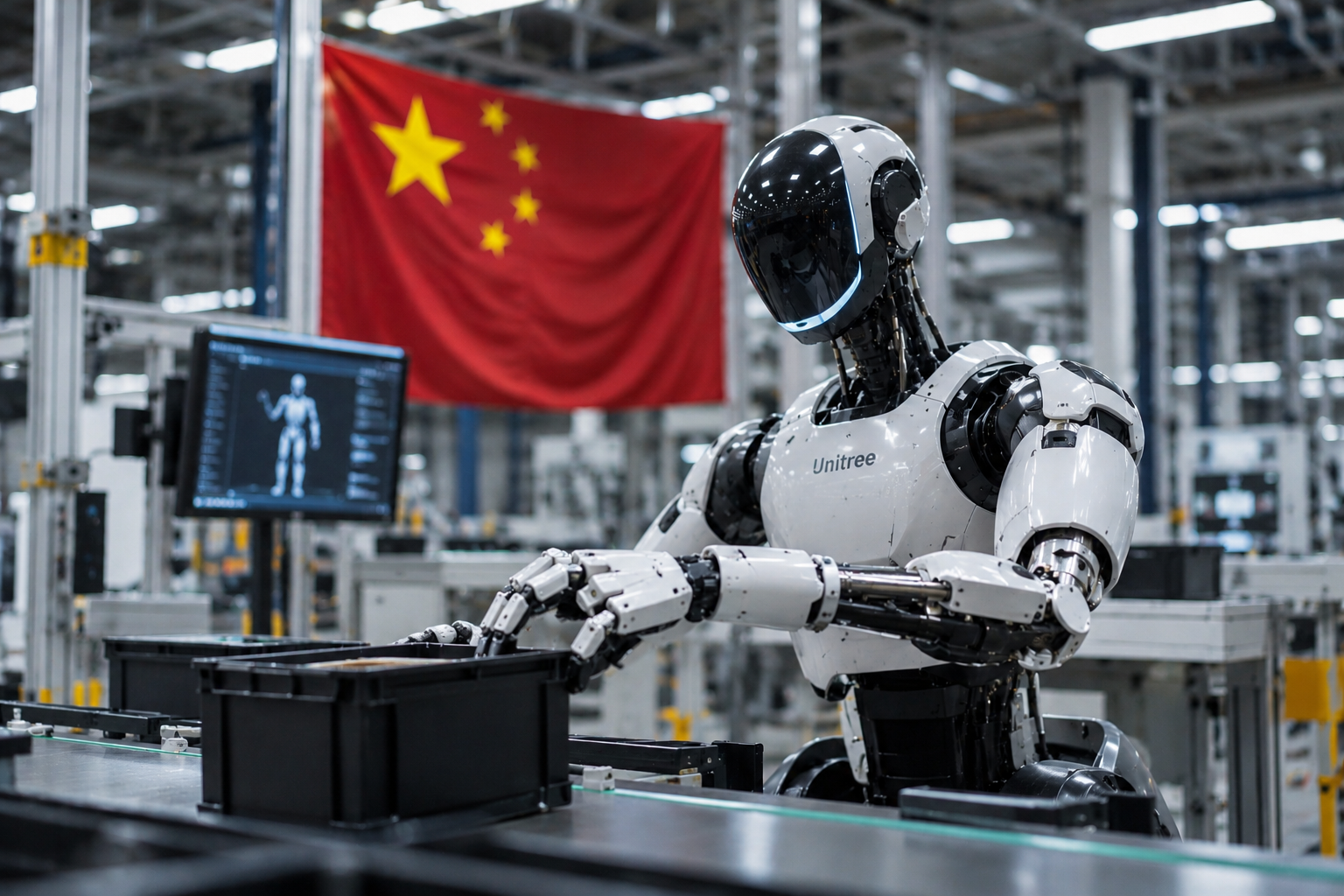


China’s humanoid robot industry is entering a new phase.
After years of rapid progress in hardware, mobility and manufacturing, Chinese robotics companies are increasingly turning their attention to the artificial intelligence systems that could allow humanoid robots to understand their surroundings, learn new tasks and adapt to unfamiliar environments.
The shift marks an important change in the sector.
Building a robot that can walk, run, dance or perform a rehearsed demonstration is one challenge. Building a machine that can reliably understand a changing workplace and complete useful tasks without constant human instruction is considerably harder.
That is now where much of the competition is moving.
From Hardware to the Robot’s “Brain”
China has developed a strong humanoid robotics manufacturing base, supported by an extensive industrial supply chain and relatively low hardware costs.
However, companies are increasingly recognising that physical capability alone will not determine whether humanoid robots become useful at scale.
The next challenge is embodied AI: artificial intelligence that allows a machine to perceive the physical world and act within it.
Chinese startups including X Square, Galaxea and Spirit AI are among the companies developing these systems, using large amounts of real-world and simulated data to teach robots how to perform increasingly complex physical tasks.
Investment in Embodied AI Accelerates
The shift toward robot intelligence is also attracting significant capital.
Investment in China’s embodied-AI sector reached around 93.5 billion yuan, approximately $13 billion, across 322 deals during the first half of 2026, according to Reuters. That was around five times the level recorded a year earlier.
The funding is helping companies build AI models, collect training data and develop the software required to make robots more adaptable.
Much like large language models learn from enormous amounts of text, humanoid robots require large volumes of physical-world data showing how objects move, how environments change and how different tasks should be completed.
Teaching Robots Through Real-World Data
One of the biggest challenges is collecting enough high-quality training data.
Companies are using several approaches.
Some train robots by recording human demonstrations, while others use wearable sensors to capture body movements and translate them into robot actions.
Simulation is another important tool, allowing developers to create virtual environments where robots can practise tasks repeatedly without the cost or risk associated with physical testing.
However, simulation has limits.
A robot that performs well in a controlled virtual environment may still struggle when confronted with unpredictable lighting, unfamiliar objects or changes in the physical world.
That gap between demonstration and dependable real-world performance remains one of the sector’s biggest technical challenges.
From Demonstrations to Useful Work
Humanoid robots have already attracted attention for performing impressive demonstrations, including running, dancing and martial-arts routines.
But the commercial opportunity depends on something much less theatrical: reliability.
Factories, warehouses and other industrial environments require machines that can repeatedly complete tasks safely and accurately.
Chinese companies are already testing humanoid robots in factories and pharmacies, but Reuters reported that dependable performance across unfamiliar workplaces remains some way off.
That makes the current phase less about proving that robots can move and more about determining whether they can think and adapt well enough to become practical tools.
China’s Manufacturing Advantage
China may have an important advantage as this technology develops.
Its large manufacturing sector provides robotics companies with access to factories, supply chains and industrial environments where robots can be tested and trained.
That gives developers opportunities to collect physical-world data in real operating conditions.
China also has a broad network of component manufacturers supplying motors, sensors, batteries and robotic joints, helping reduce development and production costs.
US companies, meanwhile, continue to hold strengths in areas including frontier AI research and advanced computing infrastructure.
The competition is therefore developing across both hardware and intelligence.
The Next Step for Humanoid Robotics
The long-term goal is to create robots that can receive relatively simple instructions and work out how to complete the task themselves.
That could eventually allow humanoid machines to operate across factories, warehouses, healthcare environments and other workplaces without being programmed individually for every movement.
Industry executives have compared the potential breakthrough to the arrival of ChatGPT, when years of underlying AI research suddenly became accessible to a much wider audience.
However, the technology has not reached that point yet.
Reliable general-purpose robotics remains a difficult engineering problem, and successful demonstrations do not necessarily translate into dependable commercial deployment.
Still, the direction of development is becoming clearer.
China’s humanoid robot industry has already made significant progress in building machines capable of increasingly sophisticated movement.
The next race is to give those machines the intelligence required to understand the physical world around them.
Disclaimer
This article is for informational purposes only and is based on publicly available information at the time of publication. It does not constitute financial, investment or technology advice. Humanoid robotics and embodied AI remain developing technologies, and commercial adoption timelines may change.
Sources
- Reuters, China’s robot makers have mastered the moves. Now comes the race for brains, November 1, 2026.
https://www.reuters.com/world/china/chinas-robot-makers-have-mastered-moves-now-comes-race-brains-2026-11-01/