


Highlights
• Wearable tracking has evolved from specialist chest straps and sensor vests to watches and discreet smart rings.
• Newer devices increasingly monitor sleep, recovery, stress and everyday health alongside exercise.
• The next phase of wearable technology may depend less on screens and more on continuous, passive measurement.
Health tracking once required equipment designed primarily for athletes, coaches and medical professionals.
Heart-rate straps measured the intensity of a training session, while sensor-filled vests helped professional teams monitor distance, speed, acceleration and physical workload.
The arrival of GPS watches brought this information into everyday life. Running pace, steps, heart rate and sleep could be measured through a familiar device worn throughout the day.
Now, the technology is becoming smaller and less visible again.
Smart rings can collect information from the finger without requiring a large screen or constant interaction. Rather than focusing only on exercise, they are designed to build a broader picture of how the body moves, sleeps, responds to stress and recovers.
From Training Equipment to Everyday Technology
Early wearable devices were generally designed to answer a specific performance question.
A chest strap could show whether an athlete was training at the intended intensity. A GPS vest could tell a coach how far a player had travelled during a match and how many high-speed efforts they had completed.
These devices remain useful because they can provide responsive measurements during intense activity. However, they are usually worn for a defined training session rather than continuously throughout the day.
That limits the information they can collect.
Exercise is only one part of a person’s physical condition. Sleep, rest, illness, stress and normal daily movement can all influence how someone feels and performs.
The expansion of consumer wearables began to connect those different parts of the day.
Watches Made Health Data Accessible
GPS watches initially focused on pace, distance and location.
Garmin released its first GPS running watch, the Forerunner 201, in 2003.¹ The early device was designed primarily to help runners record distance, pace and time without relying on manually measured routes.
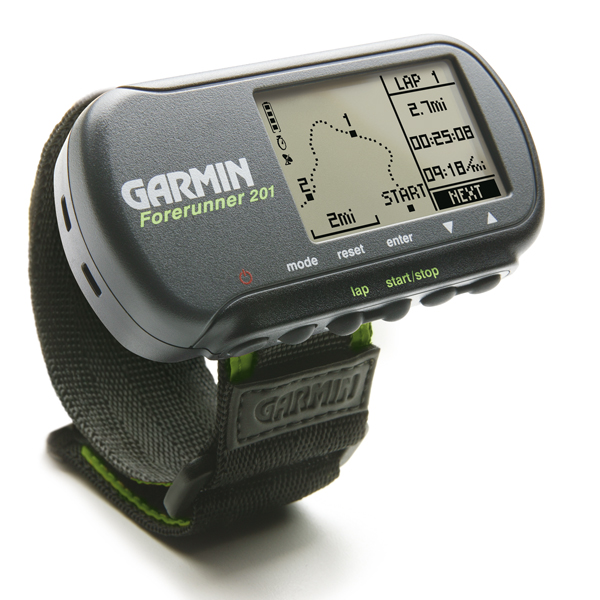
Over time, watches became smaller and gained additional sensors.
In 2015, Garmin introduced the Forerunner 235 with built-in optical heart-rate monitoring at the wrist. The watch could record heart rate without requiring the wearer to use a separate chest strap, while also tracking steps, calories and sleep.²
This helped turn physical activity into something that could be measured throughout the day.
A run was no longer described only by distance and time. It could be divided into heart-rate zones, elevation, cadence, pace and estimated recovery time.
Daily movement became a step total. Sleep became a score. Exercise goals became visual targets that could be completed, shared or compared with other users.
By placing these functions inside a familiar watch format, wearable technology moved beyond specialist sports equipment and became part of everyday consumer life.
However, the format also introduced limitations.
A smartwatch requires space for a screen, controls, notifications and a relatively large battery. Some users also find watches uncomfortable to wear overnight, creating gaps in the sleep and recovery data that increasingly shape modern health tracking.
Why Tracking Is Moving to the Finger
Smart rings approach health tracking differently.
The finger contains a dense network of blood vessels and gives a properly fitted device close contact with the skin. Optical sensors can use changes in reflected light to estimate signals such as heart rate, while additional sensors can monitor movement and skin temperature.
A 2026 research project involving 54 adults examined the use of smart rings to collect cardiovascular measurements through photoplethysmography, or PPG. The study tested the devices during controlled exercises, everyday activities and treadmill running.³
The results demonstrated the potential for discreet cardiovascular monitoring but also showed that movement can interfere with readings. During treadmill running, natural arm movements created substantial motion artefacts and reduced the accuracy of heart-rate and respiratory measurements.³
The absence of a screen is one of the ring format’s defining features.
A ring does not need to display maps, messages or live workout statistics. Information can instead be processed and presented through a connected smartphone application, allowing the physical device to remain relatively small.
This makes rings particularly suitable for passive monitoring.
Instead of asking users to repeatedly check their wrists or manually begin every measurement, the device can collect information quietly in the background and present broader patterns later.
From Recording Exercise to Understanding Recovery
The evolution of wearable technology reflects a change in what people want to understand.
Earlier devices were built mainly around questions such as:
How far did I run?
How fast was I moving?
How hard did I train?
Newer systems increasingly attempt to answer different questions:
How well did I sleep?
Has my body recovered?
Am I under more strain than usual?
Should I train hard today or allow more time for rest?
Measurements such as resting heart rate, heart-rate variability, temperature changes, sleep regularity and daily movement can be combined into readiness, recovery or stress scores.
This represents a move away from viewing health as a collection of isolated workouts.
A person may complete a strong training session but recover poorly because of disrupted sleep. Someone else may perform less formal exercise while improving their overall activity, rest and routine.
Wearables are increasingly designed to identify those relationships and provide users with a more continuous picture of their physical condition.
Health Tracking Moves Beyond Sport
The potential use of wearable devices now extends beyond individual exercise goals.
The World Health Organization is examining how wearable technology could support national monitoring of physical activity and sedentary behaviour.⁴
A WHO meeting report published in May 2026 considered how devices could be integrated into population-health monitoring systems. It examined issues including device selection, where wearables should be placed on the body, how long they should be worn and how the resulting data should be processed.⁴
A separate WHO report also identified the need for common metrics, device specifications and measurement protocols when wearable technology is used to track physical activity across populations.⁵
Many national health surveys still rely partly on people remembering and reporting how active they have been. Wearable devices can provide more frequent measurements of how people actually move, although the information produced by different devices and algorithms is not always directly comparable.
This creates both an opportunity and a problem.
Large quantities of wearable data could help researchers understand how populations move and how much time people spend inactive. However, meaningful public-health use would require consistent measurement standards and clear rules governing cost, participation, privacy, consent and data management.⁴ ⁵
More Data Does Not Always Mean More Certainty
Consumer wearables can identify patterns, but they should not be treated as replacements for professional medical assessment.
A large 2026 study examined almost 100,000 valid ring-sensor samples collected from 1,810 participants. Heart-rate measurements showed the strongest performance, while estimates of blood pressure remained more limited.⁶
The researchers reported a mean absolute error of 3.21 beats per minute for heart rate. By comparison, errors remained considerably higher for systolic and diastolic blood-pressure estimates.⁶
This illustrates an important distinction.
A wearable may be capable of collecting a signal, but that does not mean every conclusion generated from that signal has the same level of accuracy.
Sensor readings can be affected by movement, device fit, skin contact, circulation and the type of activity being performed.
A ring may be comfortable for sleep and general health monitoring, but a watch can remain more useful for a runner who wants live pace, GPS directions and workout controls. A chest strap may still provide more responsive heart-rate information during intense exercise.
The newest format does not automatically make every earlier device obsolete.
Each serves a different purpose:
Chest straps provide focused workout measurements.
Sensor vests help teams analyse sporting performance.
Watches combine health tracking with live information and navigation.
Rings prioritise discreet, continuous monitoring.
The value of each device depends on what the wearer is trying to understand.
The Risk of Tracking Everything
Health data can encourage better habits, but it can also become a source of unnecessary concern.
Someone who feels rested may worry because a device reports a poor sleep score. Another person may ignore tiredness because an application says they are ready to train.
Scores can appear precise even when they are based on estimates, assumptions and proprietary algorithms.
The information is most useful when it supports personal judgement rather than replacing it.
Long-term patterns may matter more than one unusual reading. A sustained increase in resting heart rate or repeated sleep disruption may be worth noticing, while an isolated score may simply reflect imperfect measurement or a temporary change in routine.
As devices collect more personal information, users must also decide how comfortable they are sharing details about their sleep, movement and physical condition with technology platforms.
The Disappearing Health Tracker
The direction of wearable technology is becoming clear.
Health tracking began with specialist equipment deliberately attached before exercise. It then moved to digital watches that remained visible and interactive throughout the day.
Smart rings are taking the next step by placing sensors inside something that resembles ordinary jewellery.
Future health trackers may become less noticeable still. Sensors could increasingly appear inside clothing, glasses, patches or other objects people already use.
The popularity of smaller wearables suggests that consumers do not necessarily want another screen demanding their attention. They may prefer devices that collect useful information quietly and only surface it when something meaningful changes.
The evolution from vests and straps to watches and rings is therefore about more than shrinking technology.
It reflects a broader move from recording individual workouts to building a more personal and continuous picture of everyday health.
Disclaimer: This article is for informational purposes only and does not constitute financial advice. Always conduct your own research before making investment decisions.
Sources
- https://www.garmin.com/en-GB/blog/twenty-years-of-running-with-garmin/
- https://www.garmin.com/en-US/newsroom/press-release/sports-fitness/2015-train-smarter-with-the-latest-gps-running-watches-from-garmin-introducing-the-forerunner-230-and-235-and-garmin-elevate-wrist-heart-rate-technology/
- https://pubmed.ncbi.nlm.nih.gov/42270620/
- https://www.who.int/publications/i/item/B09745
- https://www.who.int/publications/i/item/9789240116696
- https://pubmed.ncbi.nlm.nih.gov/42477400/



.png)


