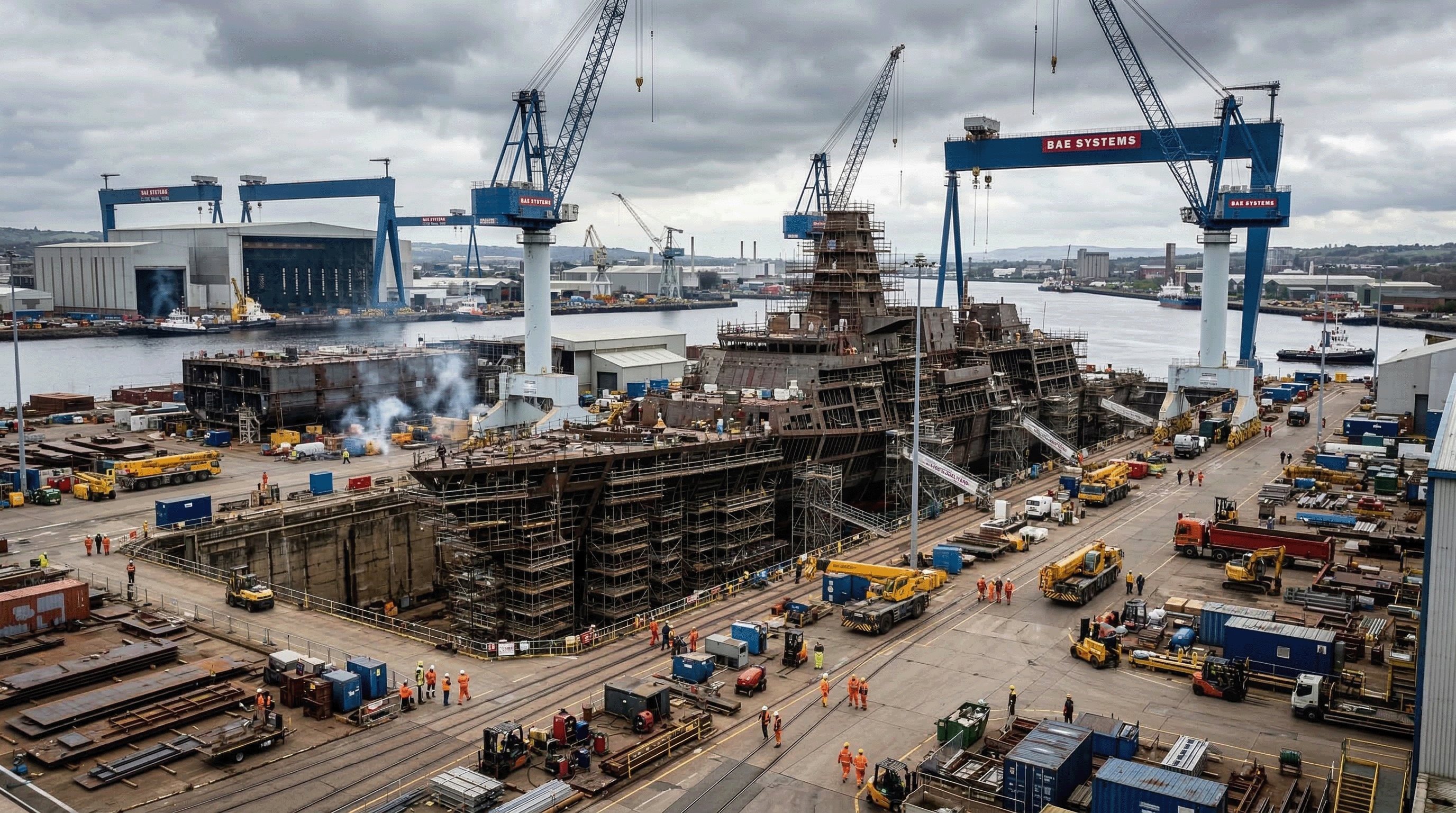


UK defence stocks are posting some of their strongest gains in years, driven by rising government spending commitments and renewed geopolitical tensions following the Hormuz crisis. But as share prices push into record territory, analysts are asking whether the rally still has room to run or whether stretched valuations now represent a genuine risk for investors.
A Record Run for the Sector
BAE Systems is up nearly 34% since the start of 2026, with shares reaching 2,300 pence on 12 March, close to a 52-week high. The company's full-year results for 2025, reported in February, showed revenue up 8% and operating profit up 12% year-on-year. BAE also posted a record order backlog of £83.6 billion, an increase of £2.7 billion on the previous year, and raised its dividend 10% to 36 pence per share. Chief executive Charles Woodburn described conditions as a "new era" for defence budgets. Rolls-Royce shares have gained more than 13% in the first two months of the year, with BAE up a further 7% in the same period as the Middle East conflict deepened in early March.
What Is Driving the Gains
The primary driver is a structural shift in government spending. At NATO's most recent summit, member states committed to raising core defence budgets to at least 3.5% of GDP by 2035. In the UK, Prime Minister Starmer has indicated he wants to accelerate the target of reaching 3% of GDP ahead of schedule, a signal that sent BAE shares up a further 2% in mid-February. The Spring Forecast confirmed the UK's largest uplift in defence spending since the Cold War, with the OBR noting that further increases may be necessary given current geopolitical conditions. Germany is simultaneously planning €649 billion in defence modernisation spending over five years, providing additional demand across the European supply chain.
The Valuation Question
The gains have not gone unnoticed by analysts, and the tone is becoming more cautious. BAE Systems currently trades on a forward price-to-earnings ratio of 28.5 times, roughly double its ten-year average of around 14 to 15 times. Rolls-Royce is more expensive still, trading at a price-to-earnings ratio of around 54. A consensus of 18 analysts covering BAE produces an average 12-month price target of 2,237 pence, which is now below the current market price. Sixteen analysts covering Rolls-Royce see a median target of 1,333 pence, implying modest upside at best. Germany's Rheinmetall, widely watched as a bellwether for the sector, saw its shares fall close to 8% in mid-March after delivering margin guidance that disappointed the market, a reminder that strong demand does not guarantee strong returns.
The Outlook for Investors
The investment case for UK defence stocks rests on the assumption that elevated spending levels are permanent rather than cyclical. Order books across the sector support that view in the near term. BAE has projected 2026 sales growth of 7% to 9%, with operating profit rising 9% to 11%. The restocking of depleted Western defence assets following years of active conflict is also expected to sustain demand well into the next decade. However, the gap between current prices and analyst targets suggests that much of this optimism is already reflected in valuations. Investors considering the sector for the first time face a different calculation than those who entered two or three years ago, when the post-Ukraine rerating was still in its early stages.