

Image credit: NASA/Bill Ingalls
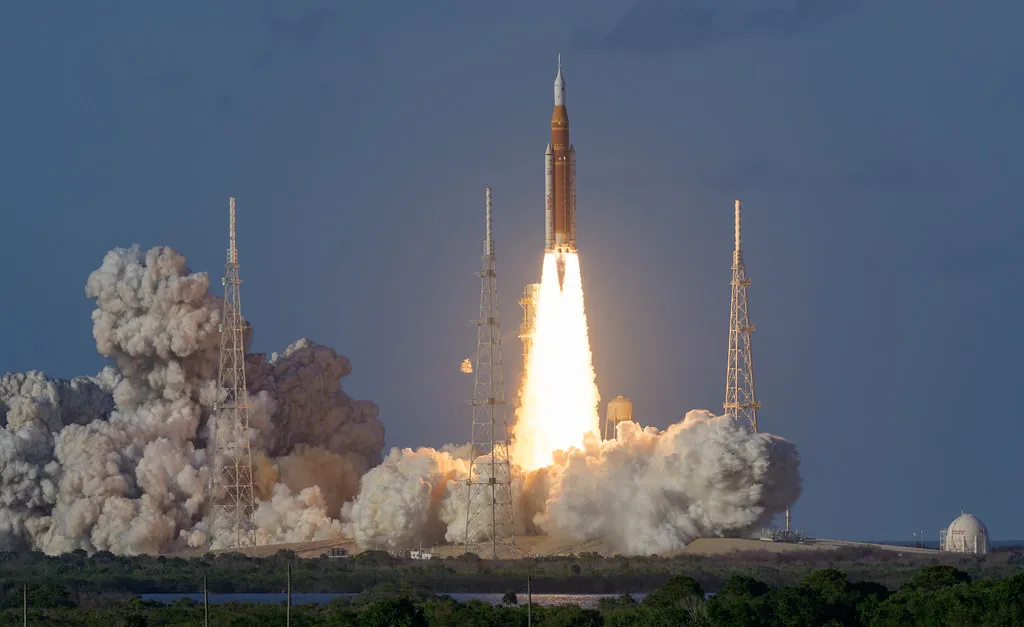
Humans are travelling beyond low Earth orbit for the first time since December 1972. NASA's Artemis II mission lifted off from Kennedy Space Center in Florida on Wednesday evening, with the Space Launch System rocket clearing Launch Complex 39B at 6:35 p.m. EDT and generating 8.8 million pounds of thrust. On board are commander Reid Wiseman, pilot Victor Glover, mission specialist Christina Koch, and Canadian Space Agency astronaut Jeremy Hansen. After more than five decades, the era of deep space human exploration has resumed.
A crew now heading for the Moon
The Orion spacecraft is following a free-return trajectory, using the Moon's gravity to loop around it before returning to Earth. The crew spent their first 24 hours in orbit around the Earth, running system checks and completing a perigee raise burn to adjust their flight path. A second critical engine burn, known as the translunar injection, has sent Orion on its four-day coast toward the Moon. The mission does not include a lunar landing. Its purpose is to test Orion's systems with a live crew on board, covering life support, communications, and manual manoeuvring. Splashdown in the Pacific Ocean is scheduled for 10 April, after a journey of approximately 252,000 miles from Earth.
History made at liftoff
The mission has already written itself into the record books. Victor Glover has become the first person of colour to travel beyond low Earth orbit. Christina Koch is the first woman to do so. Jeremy Hansen is the first non-American citizen to travel to the vicinity of the Moon. These are not incidental firsts. They represent a deliberate broadening of who participates in deep space exploration, building on commitments made by NASA and its international partners over several years. The crew follows in the path opened by Artemis I, the uncrewed test flight of November 2022, which confirmed the Space Launch System and Orion capsule were flight-ready.
What a successful mission unlocks
Artemis II is a test flight, but its significance extends well beyond the data it collects. A successful return will confirm that Orion can sustain a crew on a deep space mission, a capability that has not existed since Apollo. NASA's next planned mission, Artemis III, is targeting a crewed lunar landing in 2028. The thermal performance, life support readings, and system reliability gathered over the next nine days will feed directly into preparations for that attempt. For the first time in half a century, the question of when humans return to the lunar surface has a credible and specific answer.