



A Question from the Edge of the Universe
For more than six decades, astrophysicists have puzzled over the origin of ultra high energy cosmic rays. These particles, which travel through space at nearly the speed of light, strike Earth with energies far greater than those produced in human made particle accelerators. Yet their exact source has remained uncertain.
In early October 2025, researchers reported new findings that may help explain where these extraordinary particles come from. The study suggests that powerful winds generated near supermassive black holes could be responsible for accelerating cosmic rays to such extreme energies.
What Are Cosmic Rays?
Cosmic rays are high energy particles, mostly protons, that move through space and occasionally collide with Earth’s atmosphere. When they do, they create cascades of secondary particles that can be detected by specialised observatories on the ground.
Lower energy cosmic rays are relatively well understood and are thought to originate from sources such as exploding stars. Ultra high energy cosmic rays, however, are far rarer and far more powerful. Some carry as much energy as a well struck tennis ball, concentrated into a single subatomic particle. Explaining how nature produces such energy has been one of astrophysics’ great challenges.
The Role of Black Hole Winds
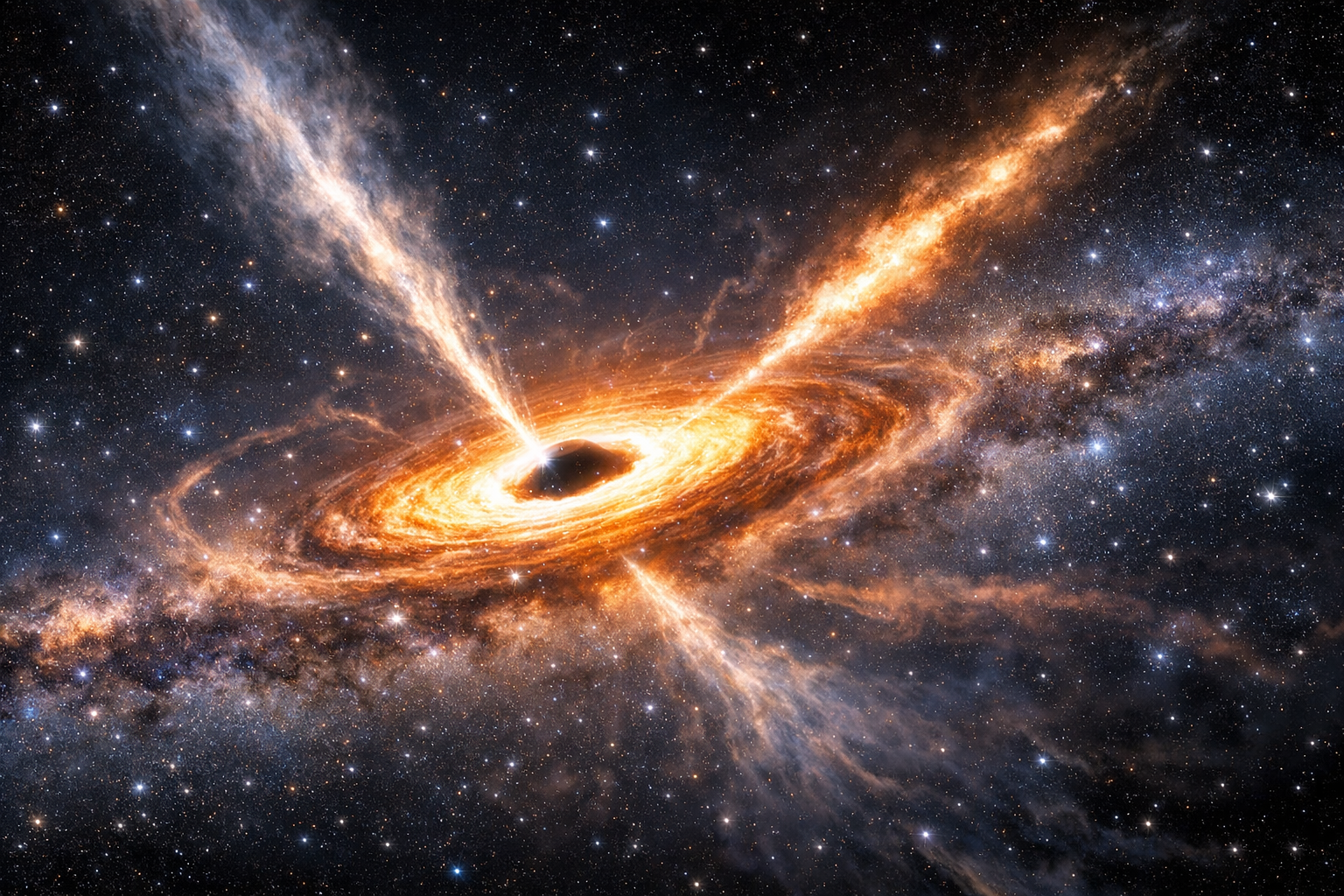
The new research focuses on the environments surrounding supermassive black holes, which sit at the centres of most galaxies. Although black holes themselves trap light and matter, the regions around them can be extremely active. As matter spirals inward, it forms a hot, rapidly rotating disc. Powerful outflows of gas and radiation can be launched outward at high speeds.
According to the researchers, these intense winds may act as natural particle accelerators. As charged particles move through turbulent magnetic fields in these outflows, they can gain energy through repeated interactions. Over time, some may reach the ultra high energies observed on Earth.
While the theory does not answer every question, it provides a plausible mechanism that fits with current observations. It also links cosmic ray production to processes already known to occur in active galaxies.
Why It Matters
Understanding the origin of ultra high energy cosmic rays is more than an academic exercise. These particles offer clues about the most energetic phenomena in the universe. By tracing their origins, scientists can learn more about black holes, galaxy formation and the behaviour of matter under extreme conditions.
The findings also highlight how much remains to be discovered about the cosmos. Even after decades of observation, the universe continues to surprise researchers with its scale and power.
Further data from international observatories will be needed to test the new theory. For now, however, the idea that black hole winds may be responsible brings scientists a step closer to solving one of space science’s longest running mysteries.


