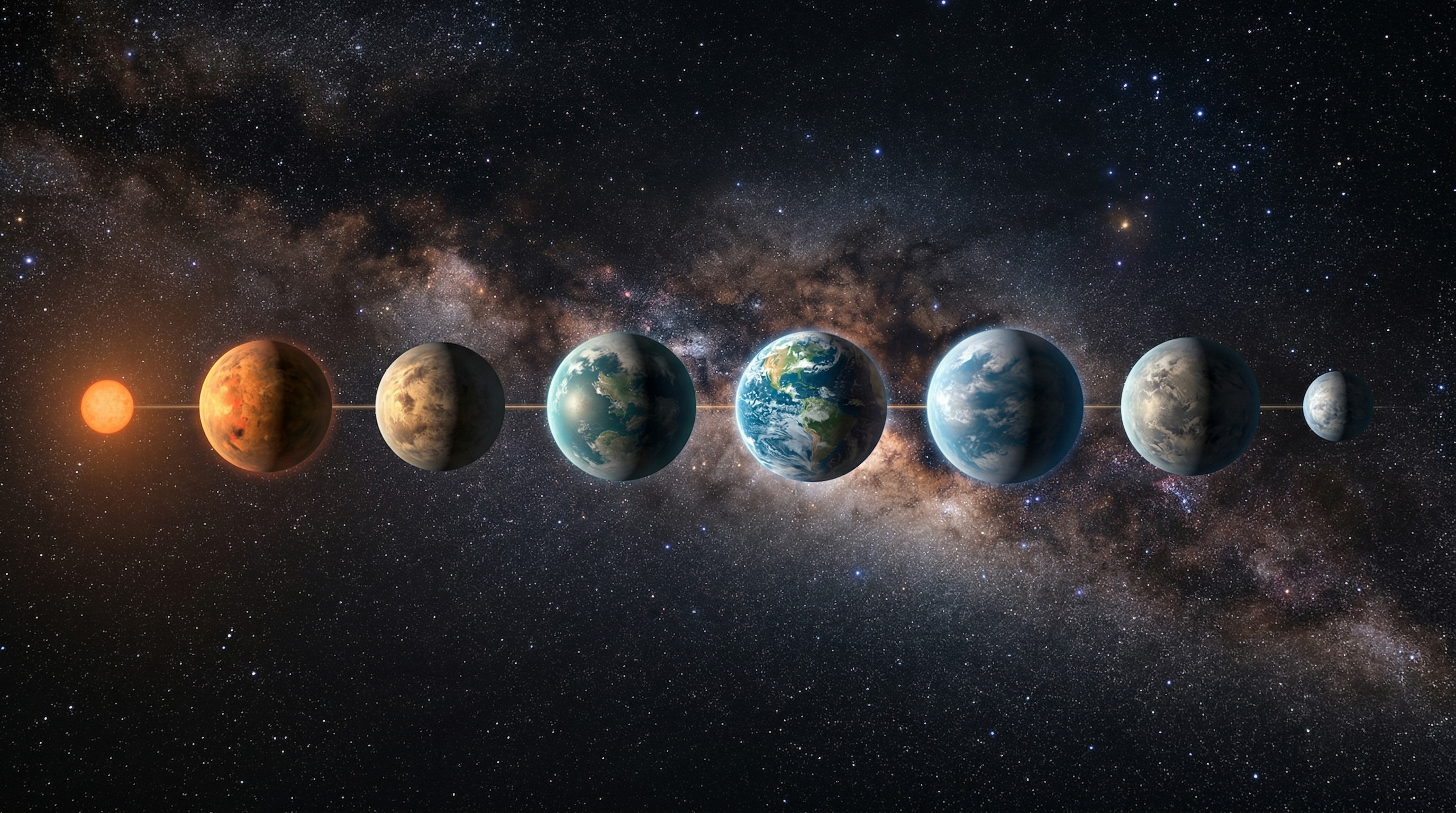


Out of more than 6,000 known planets beyond our solar system, astronomers have identified just 45 as the most promising candidates for harbouring life. The catalogue, published in the Monthly Notices of the Royal Astronomical Society on 19 March, is the result of a study led by Professor Lisa Kaltenegger at Cornell University's Carl Sagan Institute. It marks the first systematic attempt to determine which rocky worlds sit within the right conditions for liquid water to exist on their surfaces.
The work does not claim to have found life. It does something arguably more useful: it tells astronomers where to look next.
Narrowing a Very Large Haystack
Until now, the question of which exoplanets truly qualify as habitable zone candidates had not been resolved in a single, unified catalogue. Kaltenegger and her team, which includes undergraduate researchers Abigail Bohl, Lucas Lawrence, and Gillis Lowry, used updated measurements from the European Space Agency's Gaia mission alongside the NASA Exoplanet Archive to refine what is known about thousands of planets and their host stars.
The "habitable zone" refers to the orbital region around a star where temperatures could allow liquid water on a planet's surface, neither too hot nor too cold. From the full pool of confirmed exoplanets, the team identified 45 rocky worlds that meet this criterion. A more restrictive analysis, applying tighter assumptions about orbital conditions, narrows this further to 24 candidates.
The Most Promising Targets
Several well-known systems appear on the list. Four planets in the TRAPPIST-1 system, located roughly 40 light-years from Earth, are included: TRAPPIST-1 d, e, f, and g. The system is already a major focus for observations using the James Webb Space Telescope. Also featured are Proxima Centauri b, the nearest known exoplanet to our solar system, and LHS 1140 b, a so-called super-Earth approximately 48 light-years away.
The team pays particular attention to planets that receive levels of stellar radiation similar to what Earth receives from the Sun. Of the ten planets in this category, two stand out as immediate study targets: TRAPPIST-1 e and TOI-715 b. Both orbit small red dwarf stars, which makes it easier for telescopes to detect and analyse their atmospheres.
A Guide for the Next Generation of Telescopes
The timing of the catalogue reflects a broader shift in observational capability. The James Webb Space Telescope is already operational. The Nancy Grace Roman Space Telescope is scheduled for launch in 2027. The Extremely Large Telescope, currently under construction in Chile, aims for first light in 2029 and will gather light across a mirror spanning nearly 40 metres. NASA's Habitable Worlds Observatory is planned for the 2040s.
Each of these instruments will need clear priorities. Kaltenegger's catalogue is designed to provide exactly that. As co-author Gillis Lowry states, the aim is straightforward: identify the best targets for observation and focus resources accordingly.
Studying the atmospheres of these 45 worlds will help researchers determine whether any show signs of conditions suitable for life. The answers, if they come, are likely still decades away. But the shortlist now exists, and the instruments to interrogate it are arriving.