


Definitive Agreement to Acquire NanoAi Technologies
Governments are investing billions into AI and counter-drone systems. But one critical capability is largely unsolved... until now.

Disseminated on behalf of Intellistake Technologies Corp.
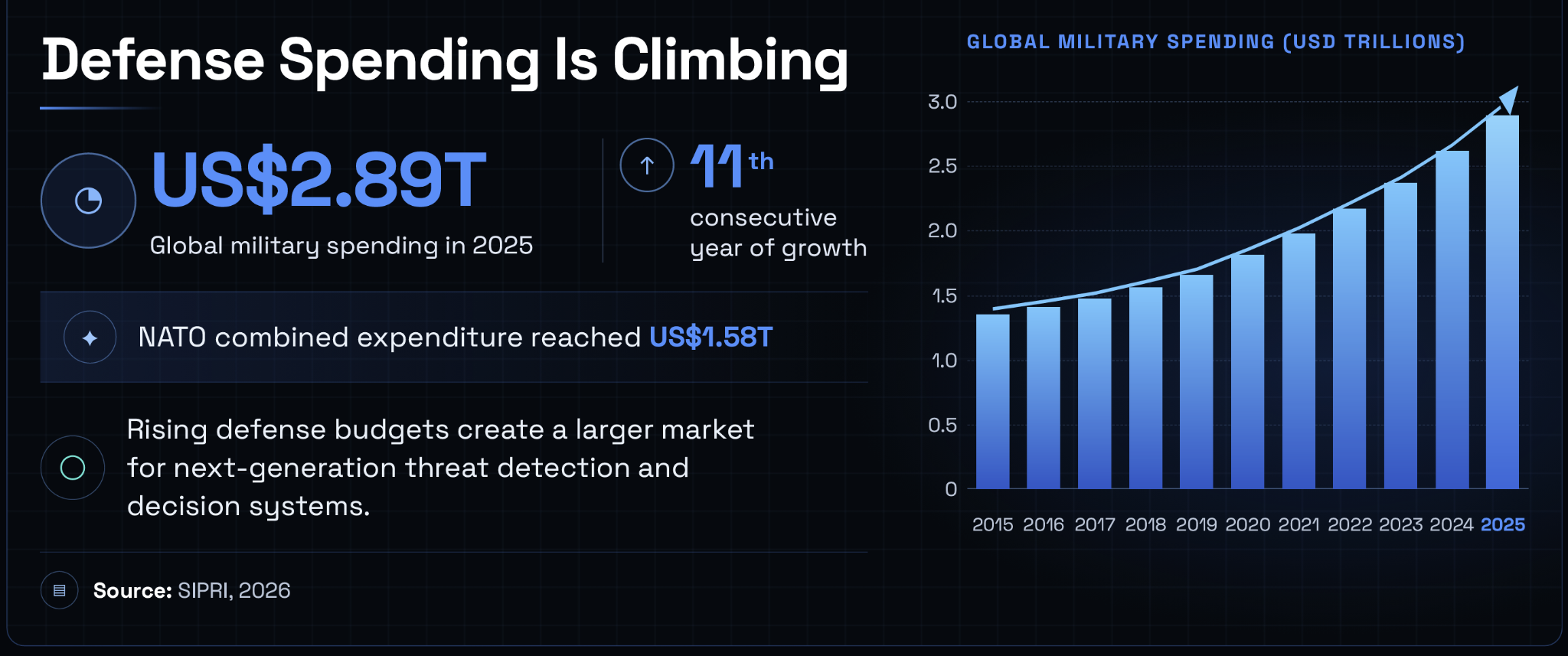
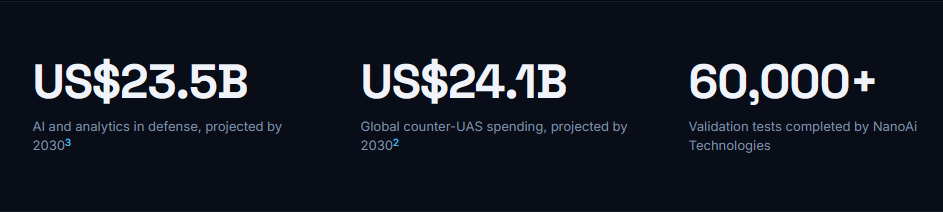
Governments across NATO and the Five Eyes spent more on defense in 2025 than at any point in recorded history.1 Counter-drone programs alone are forecast at US$12.6 billion in 2026, nearly doubling to US$24.1 billion by 2030.2 AI-driven analytics in defense is estimated at US$13.95 billion this year, projected to reach US$23.5 billion by the end of the decade.3
Two forces are driving this acceleration.
First, the threats are evolving faster than the countermeasures. Drone incursions over critical infrastructure are escalating across allied nations. Chemical, biological, and explosive threats are becoming harder to intercept with conventional surveillance. Autonomous systems are creating attack vectors that did not exist five years ago.
Second, the fentanyl crisis has turned border detection into a national security priority. Synthetic opioids are crossing borders in quantities that overwhelm traditional screening methods. The demand for portable, real-time detection in the field, not in a lab, is growing across defense, law enforcement, and public safety simultaneously.
The spending is there. The urgency is documented. But here is the gap that most investors have not considered.
Intellistake Technologies Corp. | CSE: ISTK | OTCQB: ISTKF | FSE: E41
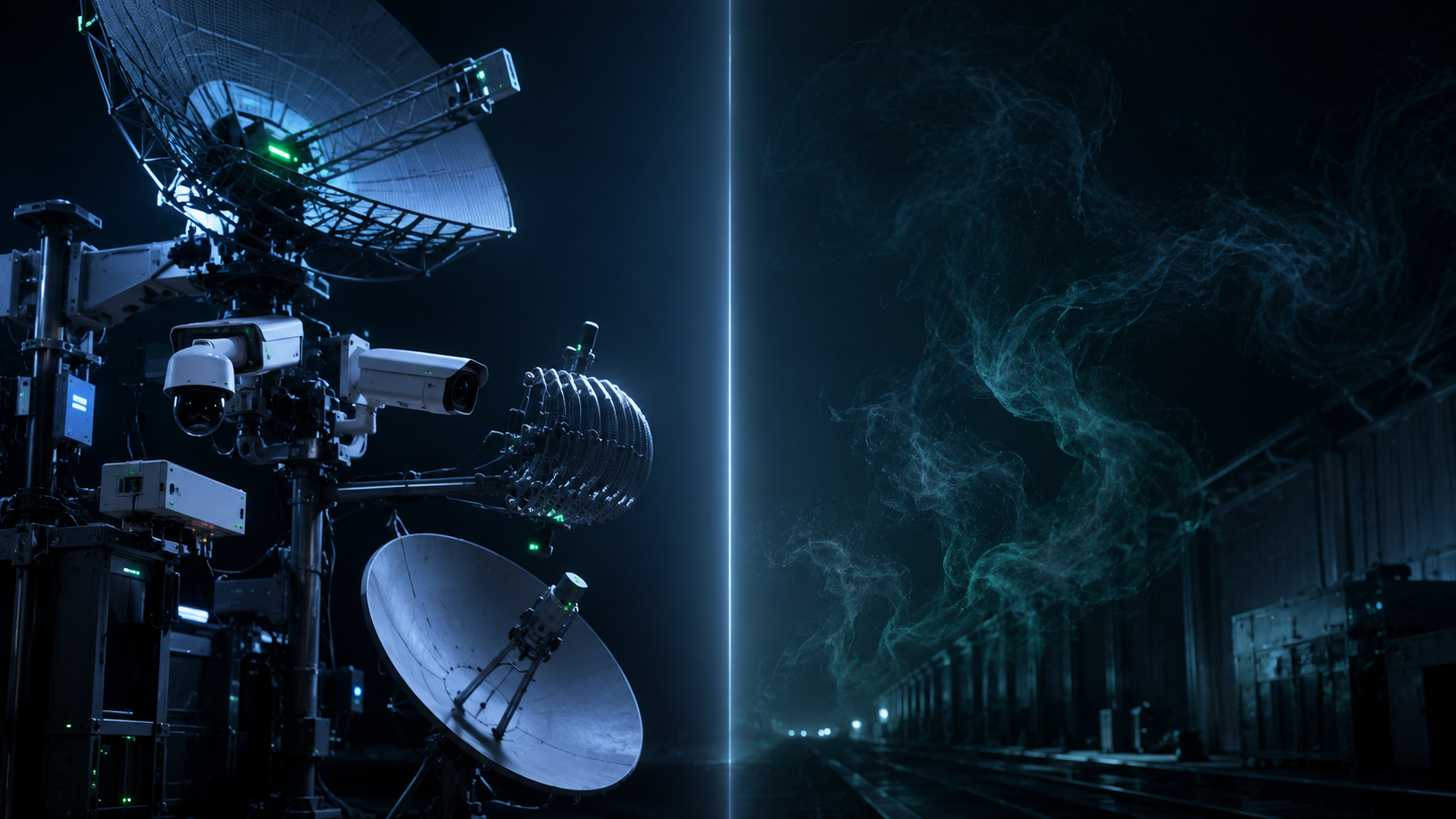
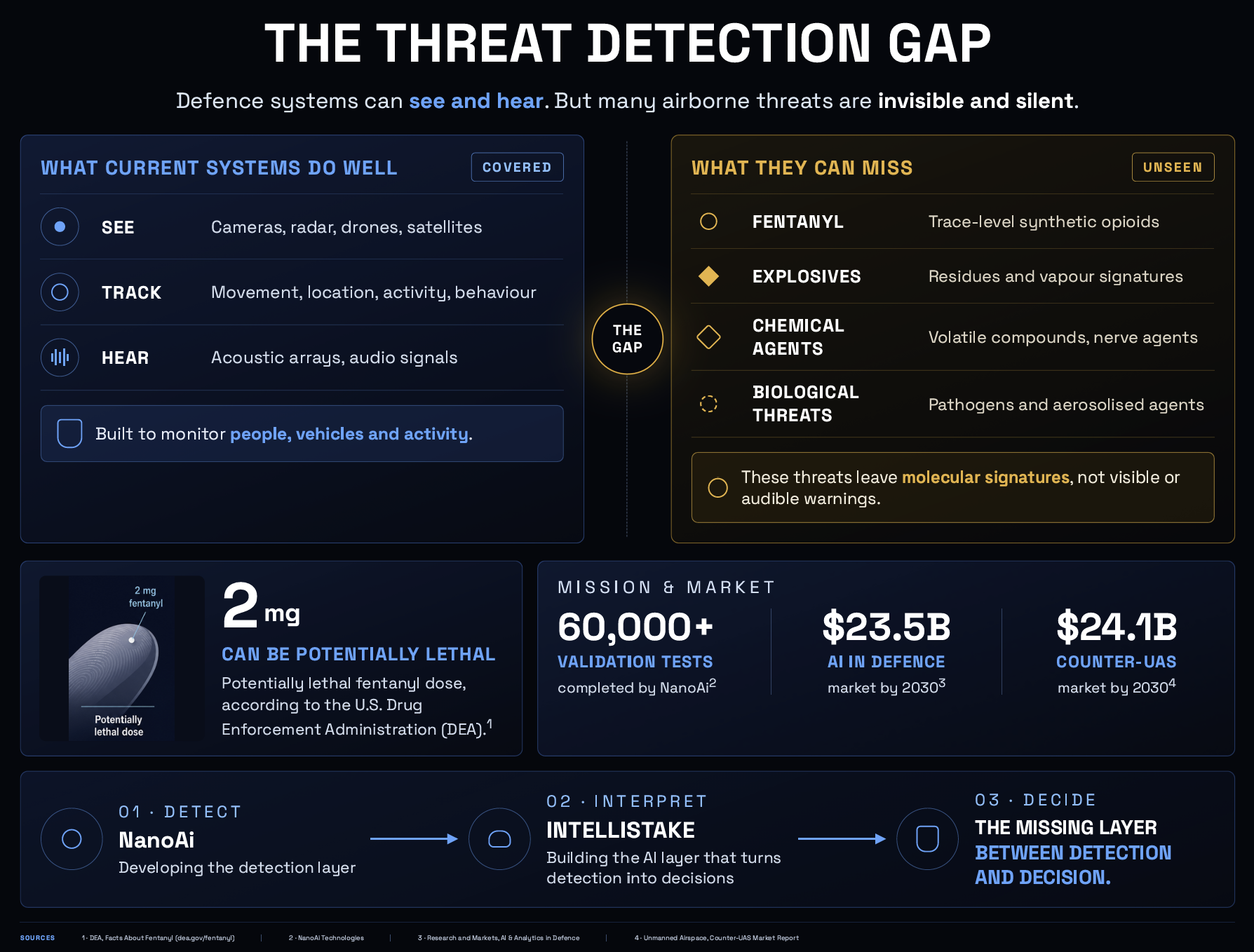
Every major defense system deployed today is built around two senses: sight and sound. Cameras, radar, satellites, acoustic arrays, and drones. Billions of dollars invested into the ability to see and hear a threat from almost any distance.
But explosives leave chemical traces in the air. So does fentanyl. So do nerve agents, biological weapons, and toxic industrial chemicals. These threats are invisible to every camera, inaudible to every microphone, and undetectable by every radar system currently in the field.
The ability to detect what is chemically present in the air, in real time, from a portable device, before it reaches a person, a building, or a crowd, is still in the early stages. That is a wide-open capability gap inside a nearly US$50 billion combined market.
And that is the gap Intellistake Technologies Corp. (CSE: ISTK | OTCQB: ISTKF | FSE: E41) has moved to address.
Intellistake (CSE: ISTK | OTCQB: ISTKF) has entered into a definitive agreement to acquire NanoAi Technologies, a company that builds portable nanotechnology-based air screening devices designed to detect explosives, chemical agents, biological threats, viruses, and illicit drugs.
NanoAi has completed more than 60,000 validation tests across its product line. The devices are lightweight, portable, and designed to operate discreetly. The company has designated product model numbers, including the SB-MU-12-424M, a multi-threat air screening device designed for drone deployment.
It serves clients across eight industries, from Defense and Aerospace to Healthcare to Maritime to Energy and Infrastructure.
NanoAi was founded by Craig Micklich, who served 13 years as a U.S. Navy SEAL before becoming a Senior Vice President at Morgan Stanley. That is detection technology built by someone who has operated in the environments where it would be deployed, and who understands the institutional capital markets required to scale it. The NanoAi team also includes a team member specializing in government contracting and public-private negotiations, a strong signal of where the company's commercial strategy is pointed.
But the acquisition story does not end with what NanoAi has built. It starts with what Intellistake (CSE: ISTK | OTCQB: ISTKF) intends to build on top of it.

Intellistake (CSE: ISTK | OTCQB: ISTKF) is a publicly traded AI and technology infrastructure company. It is not a hardware company. It is not a sensor manufacturer. It is an AI company with existing, deployed capabilities in enterprise software, data infrastructure, and intelligent automation.
Intellistake's AI agent platform is already in production. The company holds a C$278,000 contract with PowerBank Corporation for an enterprise AI agent deployment, demonstrating that the technology is real and generating revenue.
The platform is built on RAG (retrieval-augmented generation) architecture, designed to process large volumes of data, extract actionable insights, and deliver real-time intelligence through enterprise-grade SaaS infrastructure.
The company also operates data pipeline infrastructure and has capabilities across AI agents, enterprise SaaS delivery, and intelligent data management.
Now consider what happens when you pair that software infrastructure with NanoAi's detection hardware.
A sensor reading, on its own, is data. It is not a decision. The value of detecting an explosive trace or a fentanyl signature depends entirely on what happens next: how fast the data is interpreted, how accurately the threat is assessed, and how quickly the right response is triggered.
That is the layer Intellistake is designed to provide. The proposed acquisition is intended to create a sensor-to-decision capability:
NanoAi detects the threat, and Intellistake's AI agents are intended to interpret, prioritize, and route the data to the right person at the right time. Neither company delivers this alone. The proposed combination is what makes the investment thesis compelling.
To understand the scale of what this acquisition could enable, consider how threat detection works in the field today.
For invisible airborne threats, the primary tool is still a trained detection dog. Effective, but constrained by biology. One handler, one dog, one location, one shift.
Dogs fatigue after hours of continuous deployment. They require rest cycles, veterinary care, and ongoing training. They cannot be mounted on drones or robotic platforms. They cannot be deployed covertly. And they cannot screen multiple locations at the same time.
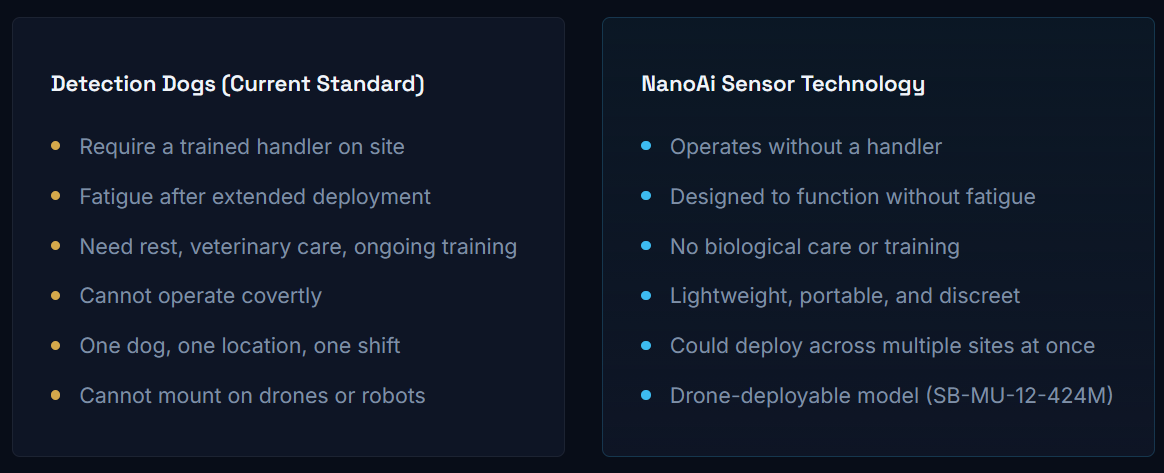
NanoAi's sensor technology is being developed at roughly the size of a thumbnail. Stackable for enhanced sensitivity. Concealable for covert operations. Designed to connect to different platforms and transmit detection data in real time.
If deployed at scale, a network of these sensors could provide persistent, multi-location coverage that no biological alternative can match. That is the kind of capability that defense departments, border agencies, and security operations could require as their budgets continue to expand.
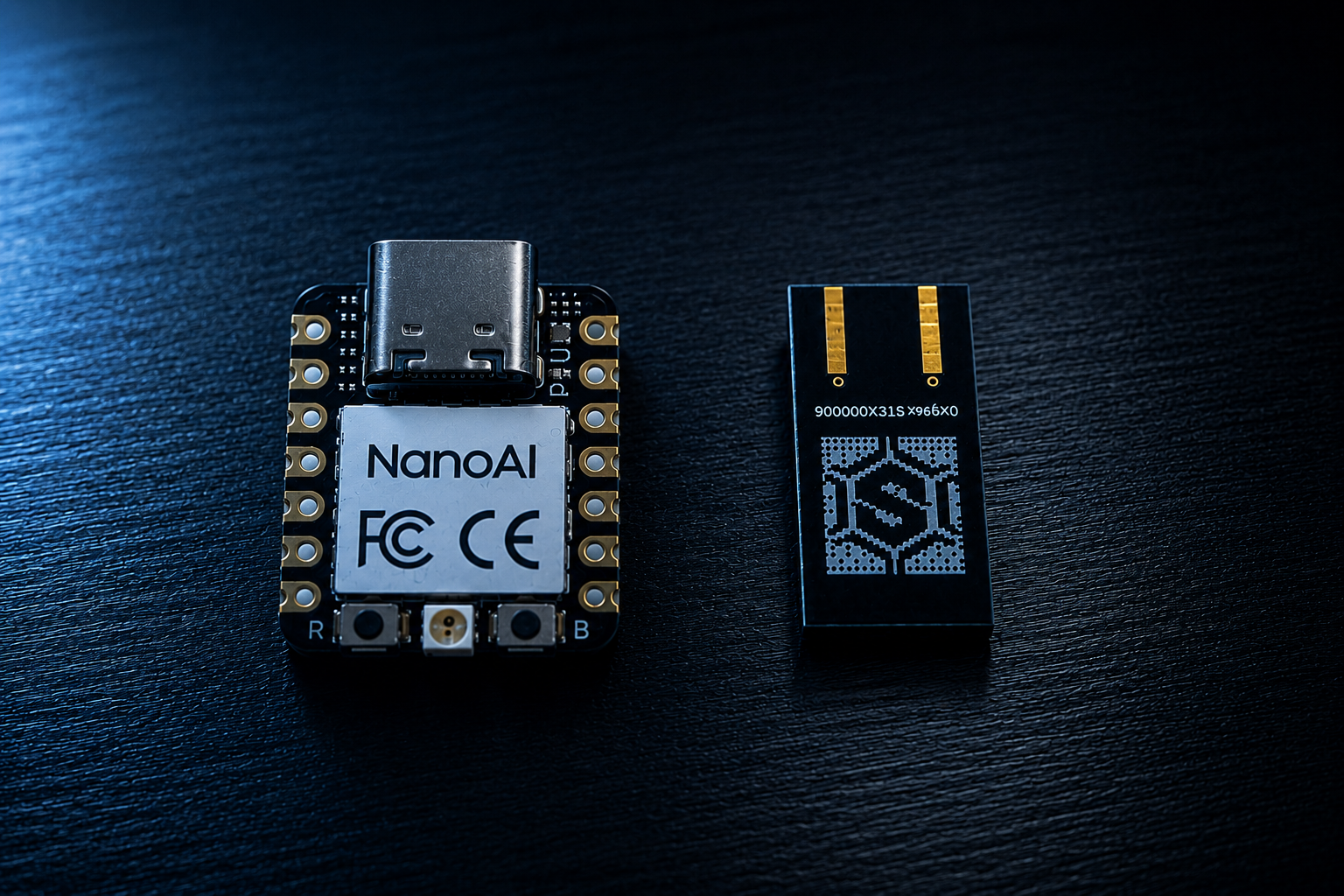
At this scale, the integration possibilities extend across nearly every form factor used in defense and security today.
Helmets and protective headwear. Body armor. Unmanned ground vehicles. Fixed infrastructure. Handheld field units. Wearable equipment for personnel on patrol.
Every platform that moves through an environment where invisible threats could be present becomes a potential carrier for persistent detection.

Think about where detection capability matters most. Border crossings that process thousands of people daily. Military bases that operate in contested territory. Airports and transit hubs that serve millions of passengers.
Government buildings. Maritime ports. Energy infrastructure. Contested airspace. These are environments protected by national-scale budgets, and those budgets are growing.
Canada has committed funding specifically to sovereign AI, sensor-fusion, and real-time situational-awareness technologies.4 Counter-drone spending is expected to nearly double between 2026 and 2030.2 NATO allies increased defense spending for the eleventh consecutive year in 2025.1
No government procurement contracts are currently confirmed. But the technology is designed for exactly these environments, and the markets it is intended to serve are the same markets absorbing tens of billions in new defense capital.
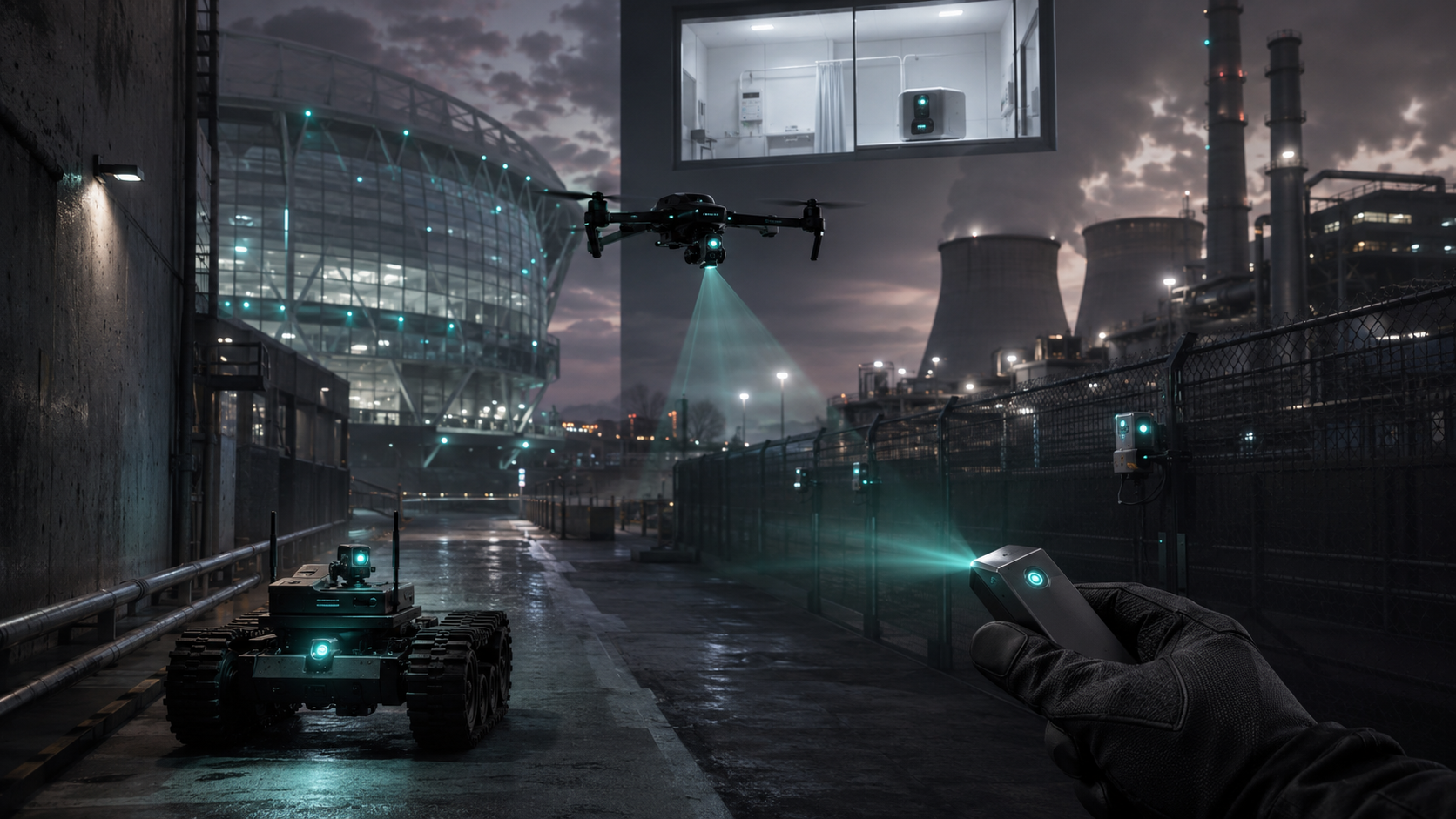
If a compact, portable sensor can detect explosives, fentanyl, biological agents, and chemical threats from the air, and if that sensor can be paired with AI software that interprets and routes the data in real time, the potential applications extend well beyond traditional defense.
Imagine a sensor integrated into an unmanned ground system, giving a robotic unit the ability to detect explosive residues or chemical agents as it moves through a building, a tunnel, or a border zone. An extra sense designed to increase survivability for the personnel who would otherwise go in first.
Compact, discreet sensors screening for explosives and illicit substances at stadiums, airports, and transit hubs. No checkpoints slowing foot traffic. No visible security infrastructure alerting a threat to its own detection.
Air screening in clinical environments. Research into breath-based and airborne biomarker detection is advancing across the healthcare sector, and sensor technology designed for precision detection could contribute to early screening for pathogens and biological indicators.
A device small enough to carry or conceal, designed to identify fentanyl and other illicit substances during field operations. No detection dog. No specialized handler. No four-hour fatigue window.
Persistent, unattended screening at borders, government buildings, energy sites, and ports. Detection that runs 24 hours a day without shift changes, without biological limitations, and without the human error that comes from fatigue.
NanoAi's SB-MU-12-424M is designed for drone deployment. An airborne sensor platform that could carry threat detection capability into contested or hazardous environments where sending a person is too dangerous, too slow, or too exposed.
These represent potential forward-looking applications. Development and deployment would depend on further engineering, integration, regulatory approvals, and market adoption. No military procurement contracts or commercial deployments are confirmed unless expressly stated in company filings.
Completion of the acquisition of NanoAi remains subject to customary conditions including completion of satisfactory due diligence (including verifying title to the intellectual property of NanoAi), completion of the audit of financial statements of NanoAi, the company maintaining a minimum cash balance of $2 million and no objection from the Canadian Securities Exchange. Closing is targeted within 60 days from the date of the definitive agreement, subject to satisfaction of closing conditions in the definitive agreement.
NanoAi has completed 60,000+ validation tests, holds designated product model numbers, serves eight industries, and has a drone-deployable device already built. This is hardware with a track record.
Intellistake has an already deployed AI agent platform, a live enterprise contract, RAG architecture, and data pipeline infrastructure already in production.
NanoAi detects the threat. Intellistake intends to interpret, prioritize, and route the data. The proposed combination is intended to create a capability that addresses a gap in nearly US$50 billion of combined defense markets.
NanoAi was built by a 13-year Navy SEAL veteran and former Morgan Stanley SVP. The team includes a VP specializing in government contracting and public-private negotiations.
Borders. Military bases. Airports. Critical infrastructure. The technology is designed for government-scale deployment in markets that are demonstrably expanding and actively funded.
Subject to closing, ISTK is intended to give investors exposure to both the sensor technology and the AI intelligence layer through a single position on the CSE or OTCQB.

Intellistake (CSE: ISTK | OTCQB: ISTKF) is an early-stage company. The acquisition is subject to closing. Market growth does not guarantee company growth, and outcomes depend on execution, regulatory approvals, market adoption, and broader conditions. But the proposed combination targets a wide-open capability gap inside a market measured in tens of billions, backed by technology with 60,000+ validation tests, a team with government contracting expertise, and AI infrastructure that is already deployed with paying clients.


